I did not remove the carriage lights to examine the termination at that point. The only “visible” violation of code would be the fire separation penetration. Because of the poor workmanship I recommended that the whole mess be evaluated by a licensed electrician, and check for a permit. A building inspector once told me that “neatness counts”. It says a lot about what to expect for workmanship.
These carriage lights? On the front of the garage? There is NO fire separation wall at the carriage lights. There is only fire separation necessary at a wall section that shares a wall with interior home space. In fact, depending on exactly where the porch light penetration is, it may not be a breach in the separation wall either, thus my comments earlier.
It depends on the AHJ. The town of Hempstead NY does not allow a homeowner to perform any electrical improvments and plumbing improvements made by the homeowner can only be performed after taking a proficiency test.
Exactly why I asked the question pertaining to restrictions prior to my making the statement.
The fire separation I was referring to is the wall between laundry room (inside the house) and garage.

As to the carriage lights, I don’t know if there is a box, proper wire nuts, etc. I didn’t remove the light to look. Fire separation is not a concern there.

Thanks for the input Jeffrey.
I didn’t find any restriction on the homeowner performing the work in this jurisdiction.
No problem. I only went as far as I did for the benefit of newer inspectors to show it is not always as it seems, and they need to look at the entire picture, and not be too focused on what is within their eyesight, as that can sometimes be out of focus.
It’s good to challenge your thinking now and again. Thanks again. Great input!
Can you imagine that groove getting mudded shut and someone coming along and nailing/screwing something through the wire?
The wire needs to be protected with adequate metal, or such.
Actually, the buyer said to me that is exactly what he would like to do. I recommended that he* not* for the exact same reasons you stated.
I would recommend that the wire be pulled out and either BX wire be installed or the original wire be installed in a conduit. As for a fire separation, we do not have such a law in Canada for fire separation from the garage.
Crazy! Was there no easy access for the “electrician” to the area above the garage? I cannot imagine this install was the easiest choice.
I agree with Larry. It will likely be covered with compound as it is an eyesore - and once it is, it will be hidden will present a risk to future homeowner. I cannot believe it was left like that to be found in the first place; although it is a good thing it was. I would have also informed the homeowner of the inherent risks and recommend it be evaluated by an electrician.
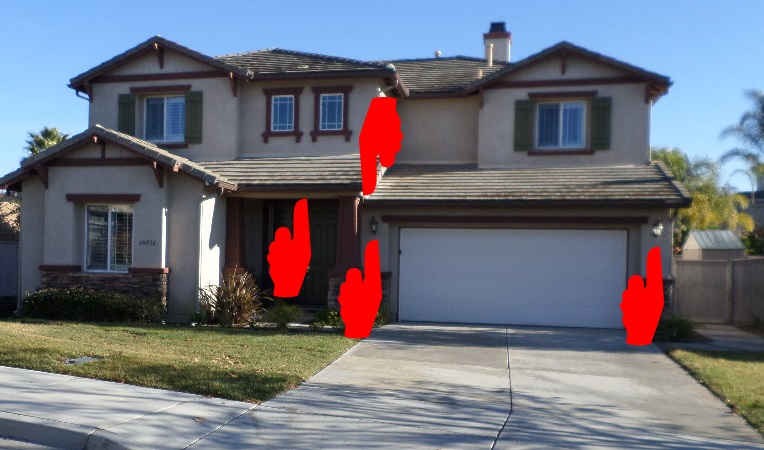
There are bedrooms above the garage. See the front elevation photo.
I know you asked but Frank had not answered yet. I was agreeing that in certian areas homeowners can make improvements in others they can not. I would also be curious to know whether NM wire is allowed in the AHJ. Brooklyn and Queens did not allow it for some time but Long Island required it.
Greg a quick look on the internet and my copy of the limited canadian national building codes shows there are some requirements about fire seperation between attached garages and residences. After the two fire fighters were killed here in Winnipeg a few years back after a garage fire breached the interior our codes were also tightened up dramatically for all new home construction and renovation construction where it pertians to garages. I did briefly look at the Alberta codes for Edmonton and they have something similar but not as strick as ours. Might be worth looking into a bit deeper. I know I am going to do it for Manitoba.
I do agree that the electrical work in the OP was shoddy at best and just plain crap at worst. As an independant contractor there is no way I would let that instllation stay as is and as an inspector I would call it out. What else is hidden. BX at the very least for the wire and sealed holes for every wall breach even if only to keep critters out.
It’s obviously a potential hazard for the reasons mentioned, but also, any time you can see poor quality electrical work, you have to wonder if there’s poor quality, potentially hazardous electrical work that you can’t see without invasive measures.