10 Easy way to save money
All very good ideas. a lot of common sense. I think this will be a great way to add to our inspection business, to generate another income other than home inspections. Some of the items this document talks about are very easy to do and not that expense. Some on the other hand are more but the home owner could budget for the bigger items and do them over time.
Attic pull-down ladders
I would say that most home owner should never put in their ladders. Most important piece to me is the check the steps for cracks, bows and or water damage. I step up one one to the third step and it broke go thing I was holding onto the ladder. The nicest ones are the slide out metal they are easy to pull down and push back up.
“H-Clips for inspectors”
H-Clips are metal clips that are used between 2 panels of wood to increase stiffness through edge support. The clips are normally used between roof sheathing which helps prevent buckling under heavy weight. Missing H-Clips should not be defect unless the building plans or jurisdiction requires it at the time it was installed.
“House Numbers”
House numbers should be visible from the road for emergency vehicles for fireman, policeman, or paramedics. Some municipalities require the numbers to be between 3 and 6 inches tall and 1/2 inch wide and a color contrast to see from the street. The numbers should be free of trees and bushes and are normally near the front entrance or on a mailbox.

The picture above is the front door and window of a 1997 Clearwater, Florida home. There are no stickers or protective covering present. The window is single pane with no markings and the door that opens in has a screen door with no markings also. No Windborne Debris Protection should be checked on the glazed and non-glazed openings chart on a Wind Mitigation Inspection Report.
I understand

This double hung window had no impact sticker on it, there was also no impact info on the glass surface. I believe these are original windows installed prior to 1994. They do not meet any of the current Fl. impact ratings.
You will find attached a couple of photos I took of a garage door and roof to wall attachment.
The garage door had 6 attachment points on the frame and had a cyclic pressure that met ANSI/DASMA 115 which would classify it as A2.
The roof to wall attachment photos show that there were clips used in the attachment area and that there are 5 nails in the upper portion and 2 nails in the lower portion. This would classify the attachment of roof to wall as B, as the metal connector did not go over the top of the truss


The attached photo is of a two story house located on Anna Maria Island. The roof measures 196 feet around the perimeter and has two gables located at both ends of the house consisting of a total of 24 feet. According to the wind mitigation formula of gable length divided by the total length of the perimeter, this roof does not qualify as a hip roof. The total area of gables in relationship to the perimeter of the roof structure is 12 percent. The total allowable percentage can be no greater than 10 percent of the total perimeter length. Bummer
When making a purchase like a house or car, credit reports will be the deciding factor as to whether or not you will get that purchase and what kind of terms will come with the offer. Like anything, credit is an essential part of our lives. There are many things that affect credit that you have control over, such as payment history and debt ratios. These two factors are the most relied upon factors in getting a loan. Fortunately for most of use, credit, over time can be healed with a good job and some discipline. Whether you like it or not, employers, the government and anyone with a potential business interest can request your credit report.
The most important thing to remember is to check your report as often as you can for potential errors and typos that adversely affect your report and score. Websites like Credit Karma allow you to monitor your score, history and even give advise as to how you can increase your credit worthiness.
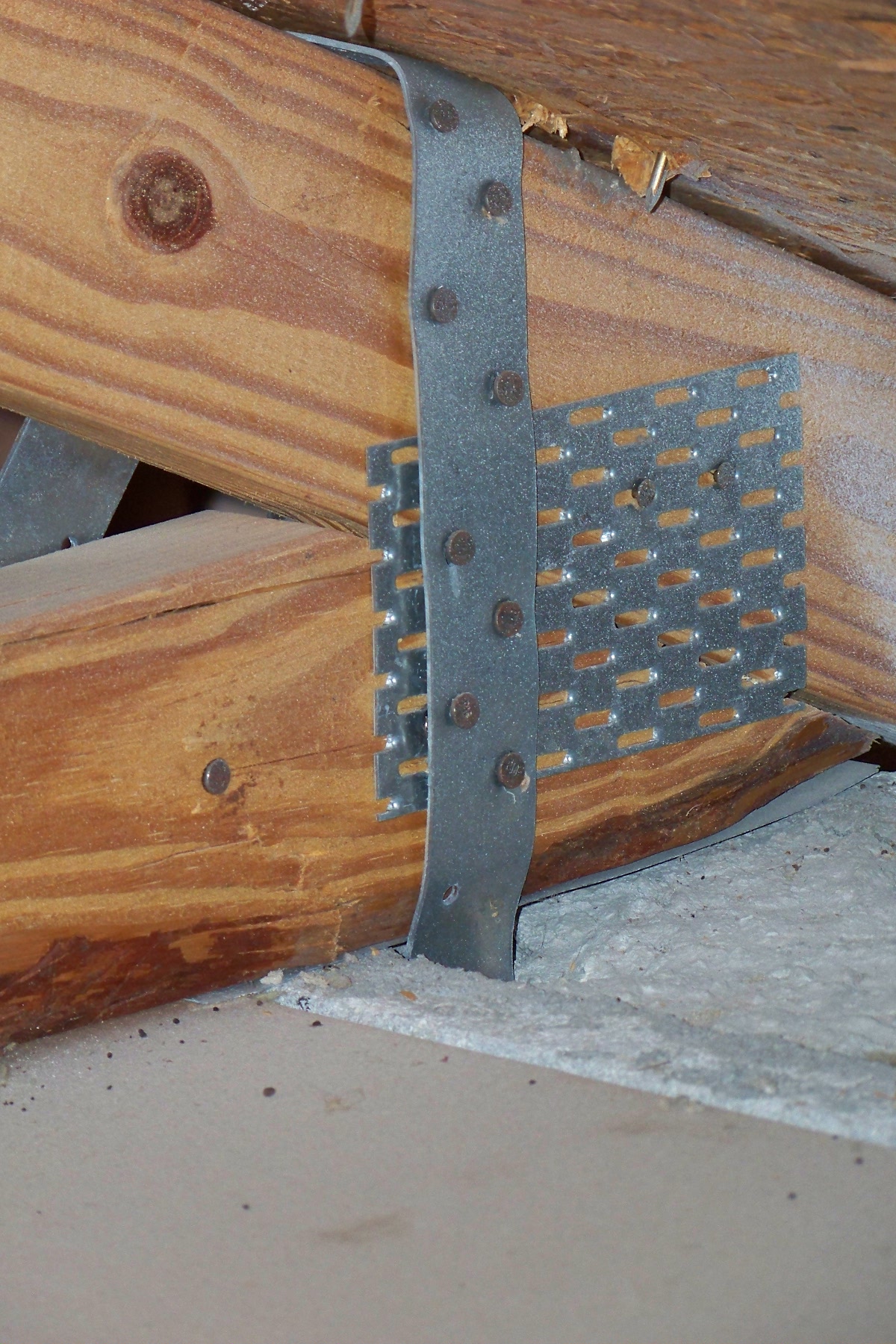
This roof to wall attachment was observed in a single family residential home on a wind mitigation inspection in 2016. The single wrap extends over the truss with the proper nail count on the front and backside (not shown) of the truss. The single wrap was free of rust or damage at time of inspection. The wrap was also the proper distance to the truss, butting directly against it. The structure had single wraps on every truss with the proper nail count and distance in relation to the associated truss. The structure was built in 2006 to the current FBC (Florida Building Code).
The articles written on electrical service panels and inspecting aluminum wiring were informative. As a Florida home inspector and having worked as a Journeyman electrician in both Florida and North Carolina the articles are helpful in pointing out the inherent dangers of the inspection industry. Electrical service panels contain hidden dangers that you may not think of besides the obvious danger of energized electrical components. I have personally seen electrical service panels with wasps, bees and even large snakes in them. The risk of opening an electrical service panel goes well beyond taking off the dead front and staying clear of the energized portions of the panel. During my inspections I would say that almost one out of every six inspections I perform contain aluminum wiring. The existence of aluminum wiring in a structure can limit the amount of available insurance providers that a home buyer will have access to. I find that it is very important to look and determine whether a structure has aluminum wiring. If not determined a client could purchase a home and later find that they will incur cost or be denied insurance if an insurance inspector finds aluminum wiring after your initial home inspection.
The typical slider was inspected and found to be impact and wind rated to MDC code. The certification sticker is attached.

I understand >
I read two articles for this class and decided that a little diversity was necessary in my article selection.
The first was Wind Mitigationby Nick Gromicko and Kenton Shepard. I found that it was an interesting article that used the Gulf Coast as good examples to support the information presented. It also was good reinforcement for the course, summarizing much of what we read. My interest was especially peaked when reviewing the checklist for wind mit, it was printed and will be carried by me to review prior to my first several inspections. Thanks, guys, it will be a great add to my kit.
The second article was No Visible Evidence Language May Be Evidence Against You by Mark Cohen and Nick Gromicko. It was a good crisp writing that put into perspective for me why some of the words we use as inspectors can be so critical when we write our reports. Hopefully none of us get into this type of situation, but the possibility for all of us is real.

This is a picture of a roof inspection performed in Port Richey, Fl.
This roof consists of a asphalt shingled main roof whose material is without
vsible evidence of damage or leaks and a secondary on the rear lanai made
of roll asphalt material. The main roof although, has 2 plumbing boots that
are leakng one has the PVC extention pipe missing and the main pipe has
dropped into the attic. This has caused leaking in the interior in many areas
damaging ceilings and wall. A Roofing professional is recommended to
further evaluate the problem. No other damage or leaks found.
The two articals i read where eleectrical panel inspection and the tools used
by home inspectors. The first was most concerning the safety when conducting
a panel inspection and the dangers that suround the panel. Caution in not rushing
through the inspection and how to identify certain panels that are notorious for
causing fires.
The second articale was concerning the different tools inspectors use to test all
areas of the constrution of the structure. Electrical testing, air quality, moisture meters, deterioration of walls and termite activity. But above all is the safety of
the inspector and anyone that is present during the inspection.
This home has an asphalt shingle man roof with material that has no visible
defects. There is although two plumbing boots that have deteriorated and are
leaking causing interior ceiling and wall damage. It is recommended a roofing
proffesional be called to further evaluate the problem. There is also a flat roll
asphalt composition roof without visible evidence of damage or leaks. No other
visible defects were found.
First reading from libray was referring to home inspector tools. Most importantly
is the safety of the inspector and any others present with proper clothing, eye protection, skin protection and air quality protection. Tool for use in electrical system, structure and air quality.
Second was the inspection of service panels which expresses the inportance of
safety in the inspection of electrical componant such as the electrical panel. Care
must be taken to insure safety above all. Also pointed out were th names of
certain panel that are notorious for causing injury and fire. Inspection of the
panel itself and coponants such as breakers, grounding bars, neutral bars and
main load bars. In all a very informative article.

This inspection which was performed in Hudson, Florida back in December of 2015 was the most recent wind mitt inspection to date. Most of the inspections that I do in Florida do not require wind mittigation inspections. Frankly, I have to give discounts to perform them. This single strap is secured properly using 3 nails, 2 on the front and 1 on the back side. The top nail on the front side is too close in my opinion and was noted on my report. I understand that 3 nails are the requirement and it really does not specify where the two nails on the front side should be.


Talking about a Rodent problem, YES, this home had rats running when they saw me. I have done nearly 400 foundation inspections last year and I have to say, This was the worse scenario I ever encountered. The fecis, the stink. I popped the panel and the smell overwhelmed me. Unfortunately, they had multiple access panels around the home. I usually do not put on my respirator, overalls and elbo length gloves from InterNachi (Which I love) to to my inspections but this one was an exception.