Just finishing up my mock inspections for certification. Learning a lot along the way. Is there anyone on this site from Indiana that can chime in? I’m trying to differentiate “code requirements” in Indiana, specific to electric, from what I learned in my coursework. Regarding AFCI, not required in any part of the home, so not a defect if a home does not have any AFCI protection, correct? According to this: Learn where the NEC is enforced. | NFPA Indiana follow the 2006 NEC. Nothing like being 20 years behind…
We are on the 2020 Indiana Residential Code which is based on the 2018 IRC and the 2017 NEC, which requires AFCI protection. But here in Allen County, contractors are given the option to use 2009 Indiana Residential Code, which exempted AFCI’s.
The plumbing-specific regulations for residential, commercial, and industrial, effective since December 2012, rely on the 2006 IPC. Yes, we are 20 years behind on plumbing code.
Your question tells me that you are already heading down the wrong path. You are not a code compliance inspector and it would be impossible for almost anyone to know all the applicable codes spanning more than a hundred years.
Inspection schools, including InterNACHI, talk about building codes because they are pandering to their audience. They are doing a disservice to inspectors. You should focus on your SOP, not building codes.
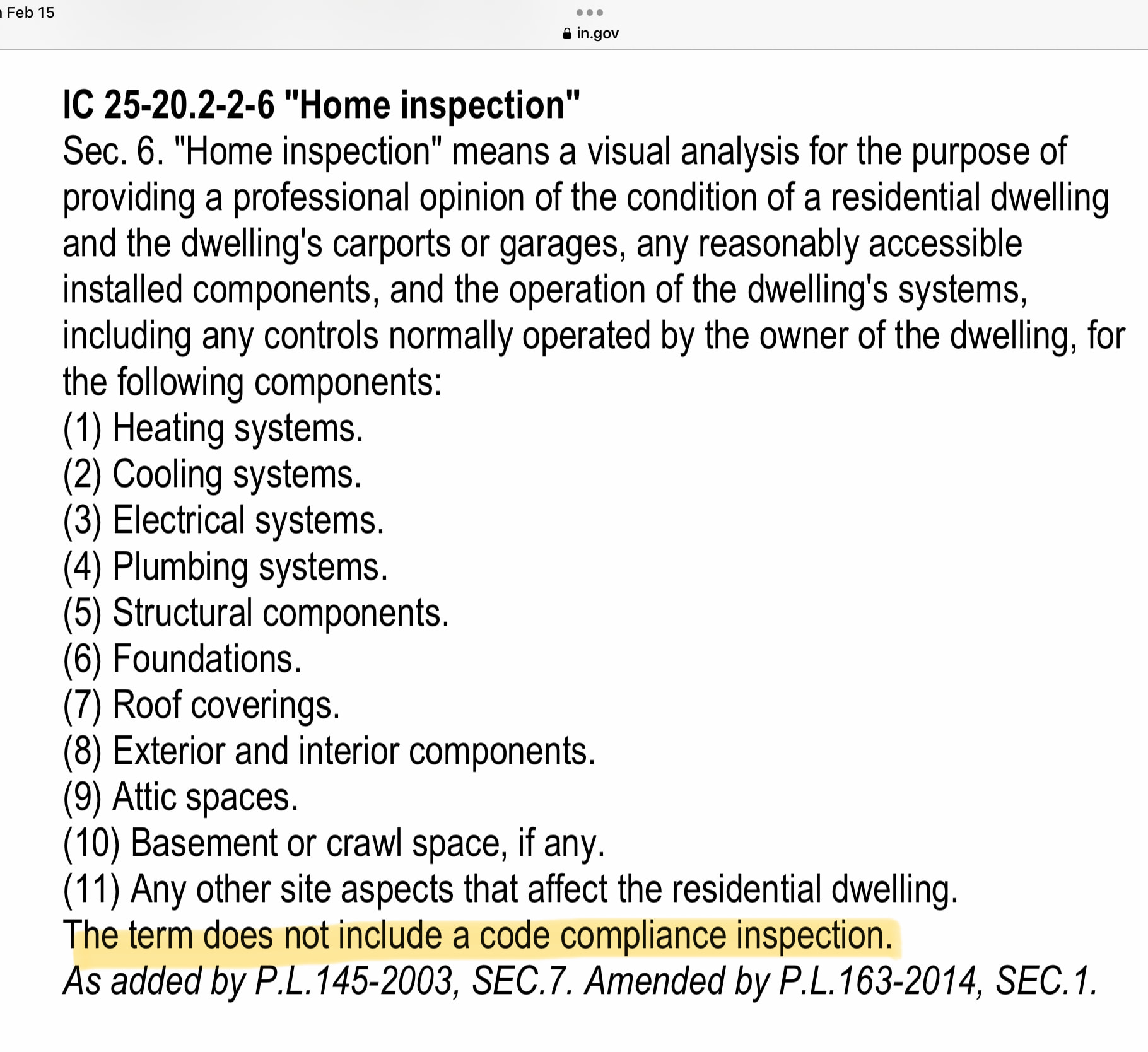
The attached image is a screenshot from the SOP on the official Indiana website. It is the official Indiana definition of a home inspection.
The short answer to your question is “No”. The absence of AFCI is not a defect.
Was AFCI protection required for branch circuits at the time when the house was built? If not then according to the NEC it’s not required now either. So unless there is a local code that says otherwise it’s not required to bring the AFCI protection in the house up to the current code.
Mikah, I agree with George, a home inspection is not a code compliance inspection. What that means is that we do not have the authority to compel someone to comply with code. We are informer’s, not enforcers.
But this doesn’t prohibit you from having code knowledge. It dispels myths and helps you unlearn some of the fallacies that InterNACHI teaches.
For instance, look at the definition of “unsafe”, as defined by Indiana SOP. It may include “a change in accepted residential construction standards”. That may include making a recommendation to upgrade to AFCI’s regardless of when the home was built. Personally, I do not.
Here is a link to current Indiana Residential Code. I bookmark each chapter to my phone for quick reference.
Some on this forum will suggest that a lack of AFCI or GFCI makes their report as a safety defect. Although I used the word defect (which I never use in a report) prefixed by the word SAFETY it remains an upgrade and would be more accurately described as a safety upgrade. I have no problem including that in a report as a convenience to clients but it will be readily dismissed as no consequence by Realtors interested in a sale.
I completely agree with you Bob, many things we inspect were code at the time a house was built, but by today’s standards they are a safety hazard. I report non AFCI-GFCI protection even on a house built 100 years ago.
We are not code compliant inspectors, we are function and safety hazard inspectors for the most part.
I don’t think to myself during an inspection, “was this code at the time it was built” I report the same on every house no matter the age or jurisdiction it is in. Many cities and counties around here follow different codes, some have their own, some have none. It doesn’t matter at all.
Another piece of advice I can give you is to unlearn the InterNACHI SOP once you’ve earned your certification. The differences between it and Indiana SOP are subtle, yet very distinct.
William, how would you put it in your report? Micah asked if it is a defect, would you report it as a defect or just make a recommendation based on modern standards? An old house is possibly going to have an older panel that may not be compatible with modern AFCI circuit breakers not to mention the possibility of having MWBC’s which may create other challenges. Around here correcting that as a defect could cost anywhere from $5000-$10,000 and may tank the deal.
That makes sense. The reports I’ve written thus far, have not included the work defect. I know Internachi is revamping the report software that they have for students, but the current platform uses defect. So, I’m just trying to figure out how to word my findings in these mock inspections, so that they are accepted. See pic. So the way I ended up wording it, was:
It is a safety recommendation that AFCI (Arc-Fault Circuit Interrupter) be installed in the following areas of the home -
Kitchens
Family Rooms
Dining Rooms
Living Rooms
Parlors, Libraries, and Dens
Bedrooms
Sunrooms
Recreation Rooms
Closets
Hallways
AFCI devices are designed to detect a dangerous, unintended electrical arc and de-energize the circuit before a fire can start. Your home does have AFCI protection in some areas of the home, but not all of the areas in the list above.
It is a safety recommendation that AFCI (Arc-Fault Circuit Interrupter) be installed in the following areas of the home.
Kitchens
Family Rooms
Dining Rooms
Living Rooms
Parlors, Libraries, and Dens
Bedrooms
Sunrooms
Recreation Rooms
Closets
Hallways
AFCI devices are designed to detect a dangerous, unintended electrical arc and de-energize the circuit before a fire can start. Your home does have AFCI protection in some areas of the home, but not all of the areas in the list above.
Thanks. I was required to review that, as part of my certification. Will review more closely to pick out the differences. Do you know if that is the most current version?
AFCI (Arc Fault Circuit Interrupter) protection was not present on required circuits in the electrical panel. Arc fault protection is designed to detect dangerous electrical arcs and immediately shut off power to prevent electrical fires. This protection is particularly important in bedrooms, living areas, and kitchen circuits where fire risk is highest. An electrical contractor should evaluate the panel and install AFCI breakers or outlets on all required circuits per current safety standards.
Also your job is to report defects, you should not worry about tanking the deal. If the house has an old panel that is not upto current standards that should also be reported, Remember It is the house that kills the deal not you.
You need to report all Defects small or large, Dangerous or not. This is your job to keep your clients safe. Nothing may ever happen if not corrected But at least you cover your ass just in case something does.
Most of the time only 10% of things make it to the repair list for repairs. I did have an inspection a few weeks ago that had 65 defects and 40 of those items made it on the repair list and I had to do a reinspection 3 times to verify all these items were done correctly.
Just so you know a safety hazard should be written up as a Major defect on the mock report as a safety hazard check box is not a choice.
Here is my narrative I use.
Also your job is to report defects, you should not worry about tanking the deal. If the house has an old panel that is not upto current standards that should also be reported, Remember It is the house that kills the deal not you.
You need to report all Defects small or large, Dangerous or not. This is your job to keep your clients safe. Nothing may ever happen if not corrected But at least you cover your ass just in case something does.
AFCI (Arc Fault Circuit Interrupter) protection was not present on required circuits in the electrical panel. Arc fault protection is designed to detect dangerous electrical arcs and immediately shut off power to prevent electrical fires. This protection is particularly important in bedrooms, living areas, and kitchen circuits where fire risk is highest. An electrical contractor should evaluate the panel and install AFCI breakers or outlets on all required circuits per current safety standards.
People are paying you for your opinion but you’re in the minority from the other opinions in this thread if you’re calling this a defect. For the record many of the electricians I know are not sold on the actually usefulness of AFCI protection. I was not required to do so by the NEC so I didn’t even put them in my own home when I recently changed the service.
i was under the impression that my job was to report on the condition of the house at the time of the inspection, not to report defects. i would not call the lack of afci’s a defect, rather a narrative along the lines of “AFCI protection was not installed in this panel. It was likely not required at the time of installation but is required in some areas now as an additional safety device.” or the like. the minute i start making choices of things being safe or not based on codes i put a major liability into all of the reports that i am not willing to take a chance on.
That’s pretty good IMO.
You may want to add something like:
This safety Improvement may not have been required or enforced by the local code authority when this service panel was installed but has been a recognize safety standard for X number of years.