As a vendor, I’ve had the chance to tag along with a few inspectors working in some tight, damp crawlspaces. A few recurring issues kept popping up:
Equipment getting moldy or fogged up, especially around connection points
Flashlights fogging internally after a while
Camera crawlers struggling to move due to floor cables or insect nests
I tried two types of gear (one DIY, and one newer model we’re distributing) to see how they hold up in 85% humidity. Has anyone here tested under similar conditions? Happy to share what we found if there’s interest.
Also curious — if you had to choose one main feature for crawlspace tools, what would it be? Durability, viewing angle, or compact size?
Afternoon to you, Van. Hope to find you well and in good spirits today.
You are a vendor of home/building inspection crawly equipment to inspect hard-to-reach areas like crawlspaces, attics, and roofs I take it?
Rubberized Wheel chains although they may come with a default for height and radius control.
Sets of Led luminaries. Note: let the vehicle acclimatize to the crawlspace environment prior operating. The should control condensation on the camera lens and lighting equipment. As well, isolate/insulate camera’s internal components converting electrical power into heat.
As to your last question. " if you had to choose one main feature for crawlspace tools, what would it be? Durability, viewing angle, or compact size?"
Angle of view. Durability and size… “within reason!”
The bottom line…our SoP does not require us to inspect those very confined crawlspaces and for the very high cost of crawlspace drones, there is little incentive to use one. They add considerable time to an inspection and regardless of how good the view is with one, it is still disappointingly easy to miss something that might have been caught when viewed in person, so a HI still needs to disclaim the heck out of a report when the crawlspace was inspected by a robot.
Thank you for your thoughtful message — I’m glad to hear from you!
Yes, you’re absolutely right. We specialize in inspection tools designed for tight and hard-to-reach areas such as crawlspaces, attics, and roofs. Your observations about rubberized wheel chains and LED lighting are spot on — we’ve also found that allowing the robot to acclimate before operation greatly reduces condensation issues. We’re currently working on improved thermal insulation for internal components, especially the camera unit, to ensure longer lifespan and stable performance in extreme environments.
As for the main feature — I couldn’t agree more. A wide viewing angle really makes all the difference during inspection. Of course, durability and compact size are essential as well, though we always aim to strike a balance between the three. Your feedback confirms that we’re on the right track.
If there’s anything specific you’re looking for — whether a demo, spec sheet, or product suggestions based on your workflow — I’d be more than happy to assist
Thank you for the honest perspective — and you make a very valid point.
We fully understand that many Standards of Practice don’t require inspecting extremely confined crawlspaces, and that using robots in those situations might not always feel justified, especially considering the investment and additional inspection time involved.
That said, we’ve found that for certain clients — particularly those dealing with insurance claims, mold/moisture issues, or older properties with inaccessible spaces — having documented footage from a crawlspace robot can provide added value, especially when used as a supplementary tool. It’s not meant to replace physical inspection entirely, but rather to enhance documentation, minimize risk, and offer access where humans can’t safely go.
And yes, disclaimers in reports are still important — but in some cases, the robot helps reduce the severity of those disclaimers by showing “something” rather than “nothing.”
We’re always open to feedback and aim to keep improving both the hardware and the workflow. If there are specific pain points you’d like to see addressed (e.g. speed, portability, battery life, or image clarity), we’d love to hear them.
Thanks again for sharing your thoughts — it’s this kind of input that helps us build better tools.
I have only had one issue with humidity and fogging with my BIGCrawler. The box bots will always lose when it comes to not getting stuck in a crawl. Just taking the easy chassis build route and patch it up with bandaids.
Really appreciate you sharing your experience — feedback from people who actually put these tools to work in the field is gold.
Totally hear you on box-style bots. We’ve seen time and again how rigid or bulky chassis tend to struggle in real crawl conditions — narrow turns, loose insulation, debris, and uneven ground. Getting stuck isn’t just frustrating, it kills inspection time and adds unnecessary risk.
That’s why our current builds focus heavily on low-profile, adaptive designs. We’ve been experimenting with articulated frames and compact, high-torque motors that allow smoother movement through tight spaces. We’re also looking into smarter traction systems — tracks or wheels that can self-adjust based on surface type and resistance.
As for humidity and fogging — that’s one area we’re actively testing right now. We’re working with internal insulation and passive condensation control so the camera and lighting stay usable without needing constant wipe-downs or ventilation.
Would love to hear more about how your BIGCrawler handled moisture and terrain. Always down to swap notes — it helps us all push the tech forward.
Kudos on your approach and frankly, if you build a much better or great product, I could be a customer. My suggestions,
great lighting with excellent exposure with very high pixels for enhancement and/or telephoto capability
just faster to scoot along though large open areas
is a 360 view capability possible?
maybe some sort of lift on the camera to reach up and view the top of some components that are not near the floor.
I get it that lots of extra features are more things to go wrong and add expense, and I have no idea where you can find that balance between features and expense.
Thank you so much for your insightful suggestions and positive feedback — we truly appreciate it.
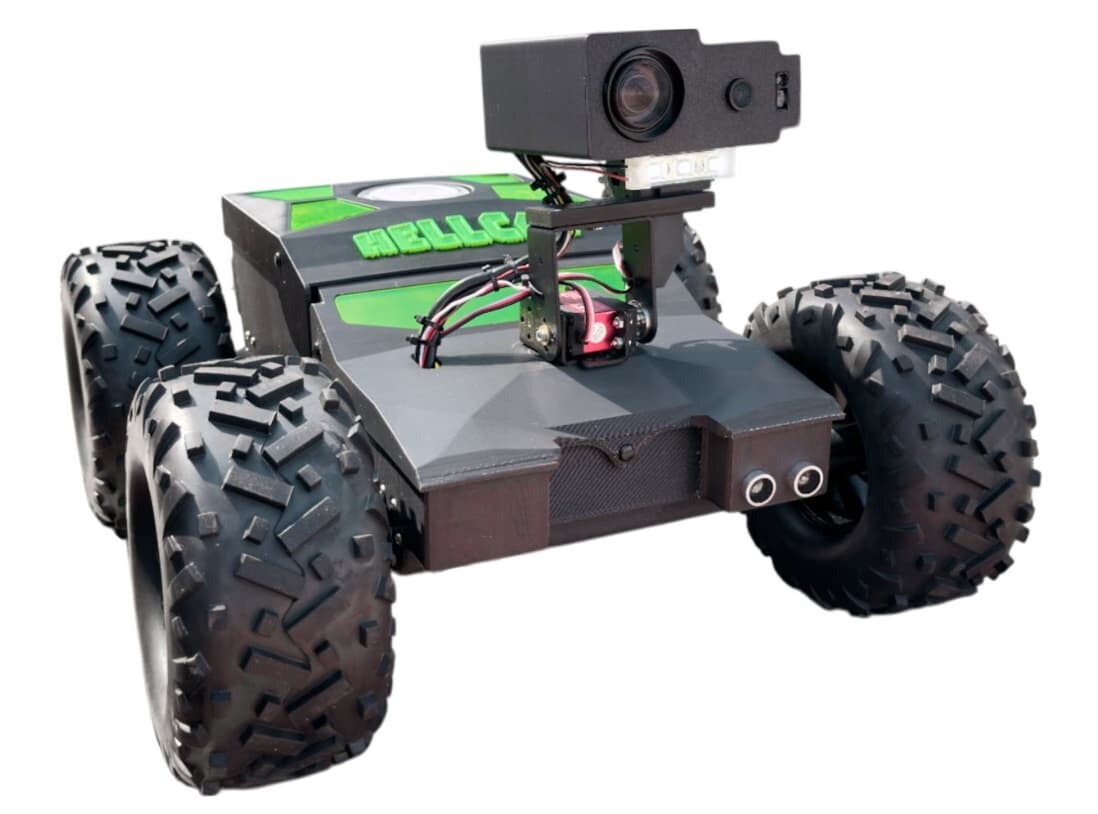
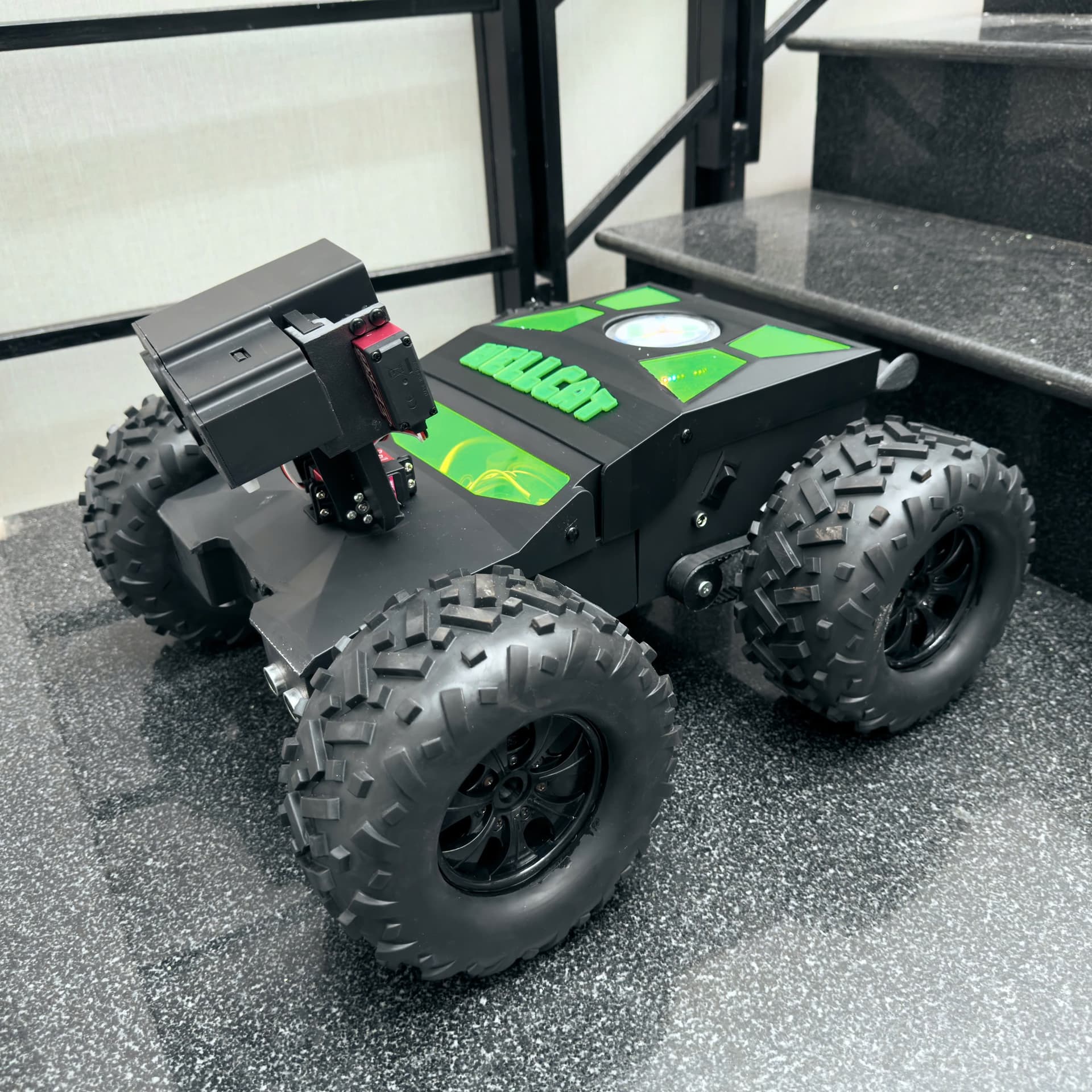
HellCat was developed specifically for professionals like you, and we’re excited to see how many of your ideas align with features already integrated into the product:
High-quality imaging & powerful lighting
The main camera features 4K+ resolution, 18× optical zoom, autofocus, and a high-intensity spotlight that moves with the camera angle — delivering sharp visuals even in low-light or complex environments.
Fast movement across wide areas
HellCat is equipped with an 8-wheel drive system (including 4 hidden auxiliary wheels with Never-Stuck technology), allowing the robot to move smoothly and stably, navigate difficult terrains, and accelerate efficiently in wide spaces without flipping or getting stuck.
Near-panoramic view with a flexible gimbal
While the camera doesn’t rotate a full 360°, its pan-tilt gimbal allows it to tilt upward and sideways, and when combined with a wide-angle lens and the robot’s ability to rotate its body, HellCat provides a nearly complete panoramic view. With a rotation range of up to 270° both horizontally and vertically, users can easily inspect hard-to-reach areas — including overhead components like ceilings, beams, or wiring — with just a few flexible joystick movements.
Extended vertical field of view
The camera can tilt upward to view areas above floor level — especially useful for inspecting ceilings, suspended systems, cables, or other elevated components.
Reliable and stable design
HellCat includes anti-flip and anti-stuck features, precise laser-based distance measurement (with only 1mm deviation), wireless joystick control, on-image/video annotation, and direct image and video storage to the tablet without downloading — helping minimize disruptions and boost inspection efficiency.
On balancing features and cost:
We fully understand your concerns — the more features, the greater the risk of failure and higher cost. That’s why HellCat focuses only on essential, field-proven features, rather than integrating technologies that don’t offer practical value.
We’re confident that HellCat leads the segment in both the number and quality of its features, while still maintaining a competitive price point — on par with or even lower than many products offering fewer capabilities.
This balance between performance, durability, and value is something we take great pride in — and it’s what truly sets HellCat apart.
We’d love to stay in touch. If you’re interested in seeing a live demo or need more technical information, we’re more than happy to assist.
I think you should offer a stripper model with no camera and a 1/4-20 stud or at least give the option to remove your camera.
If this were my product, I’d let other folks figure out the camera stuff, since they’ve been at it longer and have better equipment. Some surface mounted LEDs would probably work better than this halo light since you’re just looking upward, but it’s an option.
My point is that my 360 camera pairs with my phone and I use a camera pole. It allows a full review, anywhere you want to look.. The Insta 360X5 has low light improvements over earlier models.
I’ve been toying with the idea of a crawler, but I don’t do a ton of crawls, so it’d have to be reasonably inexpensive.
Hmmm, no link to purchase. I tried to find Torbor Technology, but the website was restricted. Hard to sell something that can’t be bought. Is that a CGI video?
We totally understand your idea of using your own 360 cam like the Insta360 X5 — it’s a great device, especially for full-room scanning.
However, after checking with our tech team, our system doesn’t currently support non-IP cameras like the X5. These types of cameras usually connect via Bluetooth and are designed for short-range pairing (20–30 ft), mostly with smartphones — so they can’t integrate directly with the robot’s remote system.
That said, we’re exploring a stripped-down version of HellCat without a camera — but even then, it would still need an IP camera to function properly.
Out of curiosity — may I ask what specific application you’re planning to use it for? Depending on that, we might be able to offer other flexible options or suggest a more tailored setup. Also, we always try to work within budget and have special pricing policies, so please don’t worry too much about cost.
The video you saw isn’t CGI — it’s been recreated using AI and advanced rendering techniques to clearly illustrate the robot’s real-world capabilities. It’s based directly on footage and imagery from our working prototype. Everything shown accurately reflects what the actual robot can do in the field.
In the video, you’ll notice the robot navigating complex terrain like uneven surfaces, tight crawlspaces, narrow ducting, and rough obstacles — all of which the real unit is built to handle during on-site inspections.
You’re absolutely right — our official website (Torbor Technology) is currently undergoing maintenance and will be back online next week. We sincerely apologize for the inconvenience.
In the meantime, we’re happy to answer any questions right here — or send you detailed product info, spec sheets, and pricing. We’re also offering early adopter perks and limited-time discounts while we finalize the website update.
Just out of curiosity — what kind of inspections do you typically perform? We offer several flexible configurations, and if we understand your needs, we can recommend an option that maximizes both performance and value.
This insta 360 x5 is controlled via WiFi, not specifically IP, like Onvif. You can get easily 150 feet without too much drama. You could also walk around the house to get closer to it.
Crawlspaces. Where I inspect, the entrance of the crawls is high and easily accessible by a human. Up at the opposite side of the home it’s often down to about 15 inches or so. I am currently using a camera pole and running the camera up into the areas I can’t reach.
Plopping my X5 onto a 1/4-20 stud and running it into those areas is a win. It could even lay sideways in a cradle of sorts just to lower the height. I would have to provide some light, but I’m doing that now.
The standard price for a full HellCat unit is $4,098 — including the robot, controller, charger, and carrying case.
That said, we’re currently offering special vendor pricing and promotional discounts while our website is under maintenance, so we’re able to provide better pricing depending on your use case or quantity.
If you’re interested, just let me know a bit about your inspection needs or how you plan to use the robot — we’ll be happy to tailor a package that offers the best value for your situation.
Looking forward to helping you find the right fit!
Dude! Your AI generated video only shows what your imagined crawler is capable of in a virtual world that you control. When you have video of a working model in real gnarly crawlspaces, come back to us. Until then, you might as well be trying to sell us a moon lander.
$4K ain’t a bad price for a real crawler, but kinda pricey for an imaginary crawler. I offer all my imaginary tools for free to my buddies.
I thought you were in design phase, looking for feature input, but now I see you’re a snake oil salesman.
At the moment, we’re preparing to release real-world testing videos so people can clearly see how it performs in tough inspection conditions — including low-clearance crawlspaces, uneven terrain, and narrow ductwork.
In the meantime, we’re using an AI-generated video, which was built based on CAD models, real prototype footage, and actual field tests, to help customers better visualize the kinds of environments HellCat can navigate.
Here’s a real test video of our previous model, X-Bot Xtream: https://www.youtube.com/watch?v=SqXavE4WNOs HellCat is a significant upgrade from X-Bot Xtream — going from 6 to 8 wheels, with a never-stuck drive design and far better terrain-handling performance.
As for the pricing: the $4K price reflects a high-performance configuration, but since our website is currently under maintenance, we’re offering early vendor and first-user discounts — so the final cost can definitely be more flexible and affordable.
Thanks again for your candid feedback — we truly appreciate it.