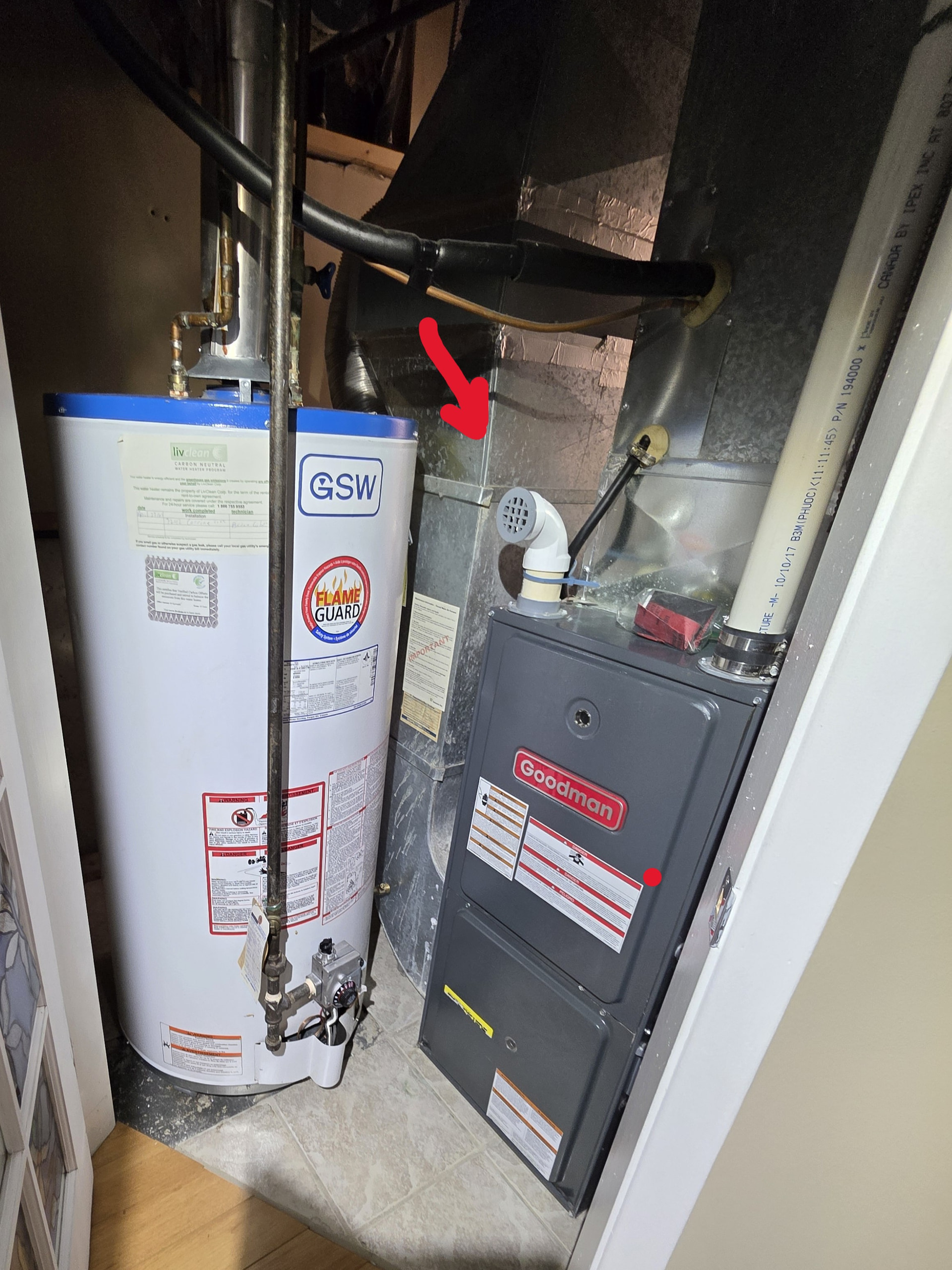
I observed this in one of the inspection today. The furnace is a high efficiency. It is drawing intake air from inside the room. Should the intake air vent not be extended all the way to the exterior? is this a defect? Thanks for you response.
Using the model number, Google the installation instructions and see what the specifications are for it.
3 Likes
To add to what Jeff said:
That depends on the amount of make up air needed?
Did you check the BTU rating and do the multiplication at 50 cubic feet per 1,000 btu aggregate input? And, then, verify with the room area.
EDIT: Don’t forget to include the water heater in the make up air calculations.
4 Likes
Thanks Jeff.
Thanks Larry. this one I did not do. i will check it. Thanks.
That installation needs follow up. That water heater has an atmosphere vented flue using a draft hood. If that water heater once shared a chimney with an abandoned furnace, it might be considered an “orphaned water heater”. If that’s the case, it might take only -2 Pascals of depressurization for it to backdraft. If not an orphaned water heater, then -5 Pascals is the limit. The furnace can easily create either of those conditions, but so can other exhausting components including bath fans, dryer, range hood, and so forth. You should alert your buyer to the potential of a serious (but repairable) safety issue being present. Issues include back drafting and CO. Recommend follow up prior to occupancy, recommend a Combustion Appliance Zone test be performed, recommend further testing of the flue and draft, and recommend installing a CO alarm in the utility room and other locations per safety standards. You need to go beyond simply calculating utility room CuFt.
5 Likes
My mind works in crazy ways and I always found it hard to calculate the 50 cubic feet/1K BTU thing….. I just do 5% of BTUs (of all appliances drawing air from the space as @lkage points out). Easier math for me to do on the fly that results in the same number.
3 Likes
Thanks Michael and Matt.
1 Like
Morning, Amar. Hope to fid you well.
Manufacture’s Model number please.
The furnace is located in a mechanical room.
Mechanical rooms act as fire barriers.
a: How does fresh air enter the mechanical room?
From what I remember, high-efficiency furnaces require #1: 'sealed PVC intake and exhaust pipes, #2: drawing fresh air from outside and venting exhaust gases out. Not drawing fresh air from a mechanical room. This is done to prevent backdrafts in tight homes.
That naturally vented gas fired water heater may contribute back drafting.
That’s my wag.
1 Like
Thanks and good morning Robert. Really appreciate your feedback. I was not able to locate the model umber. This is almost 16 years old furnace.
The possibility of back drafting is real. So, I am marking it as “Further evaluation required through a licensed and qualified HVAC technician.”
Happy holidays.
2 Likes
The quick answer is that configuration is fine if the room has adequate volume. Matt and Larry demonstrated the math. Add the BTUs of both the furnace and water heater. Or does the room have combustion air accessed from the exterior.
4 Likes
Thanks Lon. The unit is located in a small mechanical + laundry room at basement. There is no window and additional ventilation. This is why I was little concerned. Thanks.
1 Like
Take the cover off. Furnace model/serial numbers are generally legible for decades, unlike the exterior components. I recommend getting into the habit of doing so, it will serve you and your client well.

1 Like
Thank Brian. I normally do take the cover off and take a picture of the specs behind, but this one was missed. Actually got distracted by client and realtor around. Thanks again and happy holidays.
1 Like
Honest response. And something you will need to reign in quickly. (another topic-maintaining control of your inspection and process)
Are you suggesting further follow-up because of “ifs and maybes?” What if the installer took in all those considerations, did all the math and did the CAZ test?
or do we just suggest this anytime combustion air is provided from the interior? (something to consider)
Observations: The furnace that @achand pictured takes combustion air from the utility room. He later mentioned that the utility room is small, there is no outside combustion air source, and there is a dryer in there. The water heater has a draft hood. We don’t know if a CAZ test was performed.
Known facts: That water heater venting exceeds depressurization limits at -2 to -5 Pascals. That level of depressurization is very easy to establish. My speculation and a significant $$$ bet is that a CAZ test would fail in that utility room. On my report, the conditions the OP reported would be a Safety issue to be resolved prior to occupancy.
Different conditions: If makeup air was present, or if that installation was in an open basement, I’d probably be happy. If it passed a properly performed CAZ test, I’d be happy. Edit: If the water heater was power vented, I might be happy, or not.
Here’s why I call it: I became aware of a CO issue last week, that for the presence of CO alarms, there otherwise would have been a family of 6 from this area who would have died. We have CO deaths in this community every 3 > 5 years.
4 Likes
Afternoon, Lon. Hope to find you well.
This subject has come up on various times. High efficiency furnace fresh air intake location rules.
That said: As home inspectors and not technicians, should we be determining Adequate fresh air intake volume of a high efficiency furnace in a space?
SoP: Exclusions (Shall Not Do)
- Measure airflow, temperature uniformity, or BTU capacity.
- Inspect portable units, electronic air filters, or internal flues/chimneys.
- Check electrical current, coolant levels, or leakage.
- Bypass locked thermostats.
- Perform detailed analyses like combustion analysis or refrigerant charging.
1 Like
Afternoon, Brian. Hope to find you well.
I am of the opinion, high efficiency furnace covers are best left alone.
Do not ever operate the furnace with the cover off, as it is a safety hazard and can cause the unit to stop working or be damaged.
I also ran into gaskets and seals issues.
If you do, you are walking into a needless liability issues.
That’s my wag.
Have a great day.
1 Like
Yeah well, I understand you do not care to remove covers (not only electrical panels, but now furnaces)
So, how is he to accomplish this exactly without removing the cover?
Well, that depends on several variables, one of which is the manufacturer’s installation guide. It is not a requirement in every jurisdiction or every manufacturer.
5 Likes