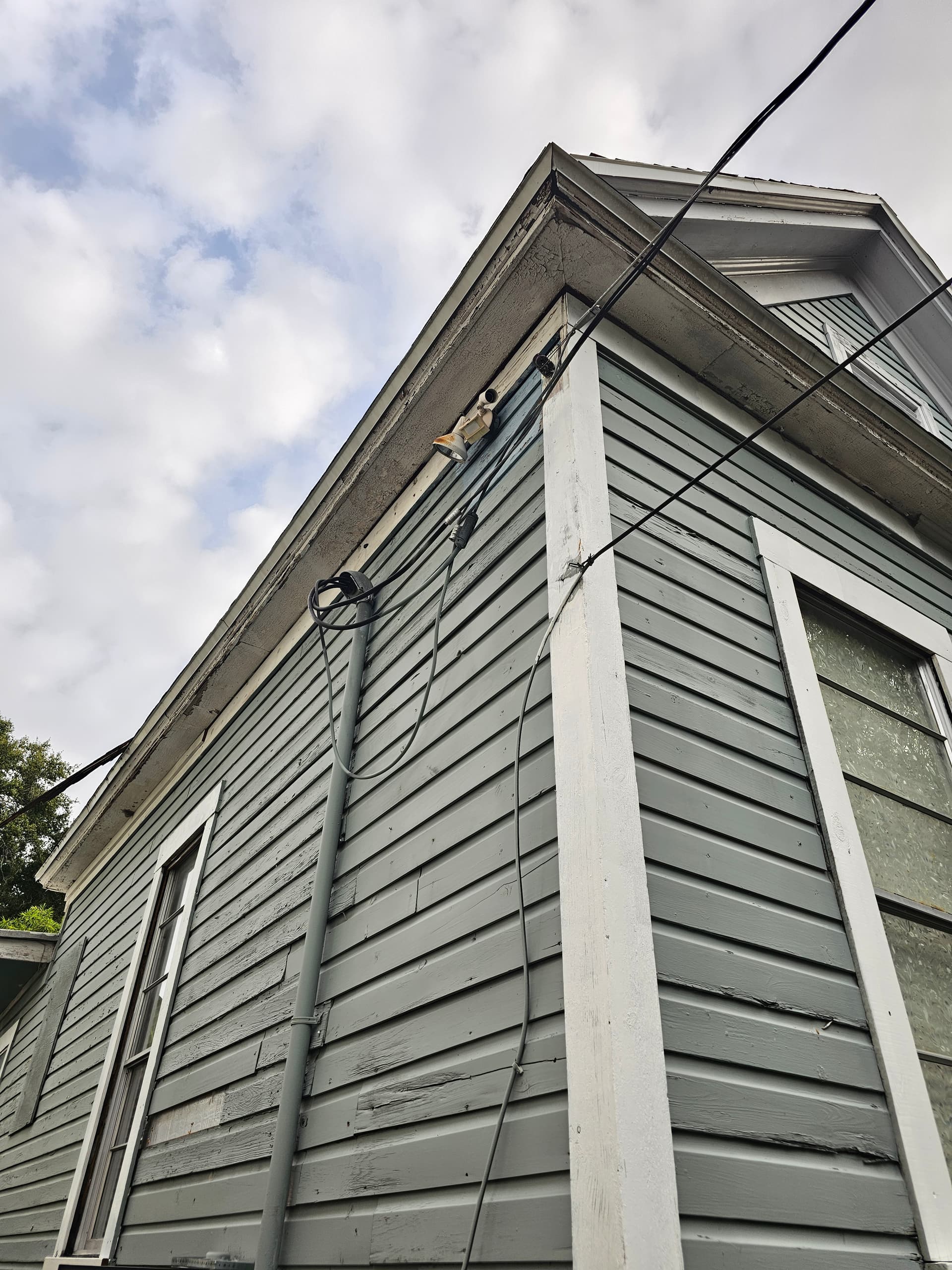
Overhead Service line missing covers at the crimp connections. One of the hot lines is actually touching the neutral, how is this not shorting out?

5 Likes

Yes, it actually looks like they are welded together.
The service panel was missing a bonding screw, not sure if that would have anything to do with it..
Wouldn’t the neutral or one ungrounded conductor have to be disconnected at the transformer for something like this to be taking place?
Do you have any other angles? It’s possible that they are not actually touching and it just appears that way from this angle.

1 Like
Unfortunately, no
It certainly appears that the conductors are in direct contact with each other, and possibly welded together. One possibility is that the integrity of the grounded neutral conductor has been compromised elsewhere and the differential current is following on an alternative path. While highly unusual, it is possible in a well balanced system, and where the resistance is sufficiently high at the point of contact, that there is not sufficient current to blow the fuse on the primary side of the transformer or cause signs of physical damage.
The conductors are in free air and US ampacity ratings for conductors are very conservative, so one possibility is that there is a relatively high resistance at the point of contact thereby limiting current flow and, thus, preventing the primary side fuse from blowing even though the ungrounded and grounded connections are touching each other. The heat from the point of contact could be rapidly dissipating so the supply transformer sees it as just another innocuous load.
As I said, the balance of loading will influence the amount of load the grounded conductor has to carry. In a perfectly balanced system (which doesn’t exist in real life), the fact that the conductors are in direct contact with each other would be affected only by the resistance where they are in contact with each other.
5 Likes
Morning, George. Hope to find you well.
I went reading various articles on aluminum properties to explain if the neutral and power cables are in contact, why no material degradation. Aluminum oxide is an electrical insulator and does not conduct electricity very well in its solid form. Aluminum oxide has relatively high thermal conductivity. It can transfer heat effectively, but it does not conduct electricity effectively. Could oxides coating the exterior prevent short circuiting and arcing?
1 Like
That looks crazy, but the explanation may be pretty banal.
That is definitely a “call out” for me, regardless of the fact that somehow, someway it is working.
3 Likes
Looks like an old home (age?)… Knob&Tube?
Got pics of the panel, and other such?
Such as with Knob&Tube?? 
That is curious! It looks like some corrosion between the two conductors that may be enough to insulate it, but when it does get a good connection it will create an arching explosion (Recommend immediate repair)
2 Likes
Not necessarily, but that is the most likely cause. It’s the first thing I’d look for. It is possible for a loss of the neutral to go undetected for a while, sometimes a long while. That’s especially true in a well balanced system.
Not likely. When confronted with unusual stuff like this, I use an Ammeter to check for current flow in unlikely places like the EGC, GEC, water pipes, and gas pipes. One of the main reasons we try to only connect the system grounded conductor and grounding conductors as far upstream as is practical is to reduce the likelihood of currents flowing where they shouldn’t be. But, having currents flowing in places like metallic gas and water lines is more common than you might think.
Actually, probably not. At 120VAC, they just burn and throw off sparks until the fault is cleared or the primary fuse blows. Incidentally, the primary fuse almost never blows. The fault usually burns itself out.
Yes. Assuming there is 240V present at the house and the neutral is intact, that would be the next most likely explanation.
It could very well be that there is current flowing at the point of contact, but as I said in an earlier comment, there could be enough resistance at the point of contact that it little or no current is flowing. It is more likely than not that some current is flowing. But, as I said earlier, it is possible that any heat being generated could be rapidly dissipated with it being in free air.
4 Likes
Thank you for the clarification.
1 Like
The home was 100 years old, and did have some original knob and tube still in place, but not live. The home has been re-wired with romex
2 Likes
Did you check it with your IR?
No! Too bad I didnt think of that when I had it out..
1 Like