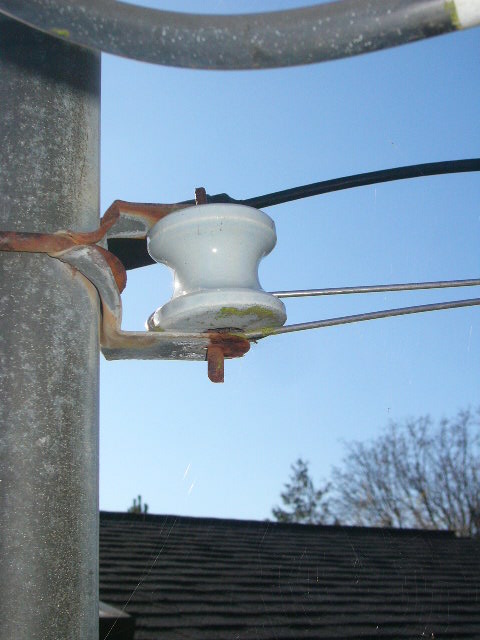
If the service neutral is bonded to ground at the service panel, does a short to ground at the electrical mast result in any safety issue? What would have to go wrong for this manifest in an injury?
I found this at today’s inspection and informed the cient and home owner, who was present. The owner called the utility, who arrived an hour later. The utility employee imformed the owner that it was not a problem and did not need to be fixed, though he did fix it after the owner asked him to.
Since the mast is bonded to the service neutral in the meter enclosure, electrically I don’t really see a problem. But since the fix was simple one it doesn’t hurt to keep it isolated.
I am not sure I see a problem either, but I suspect there probably is one even if I don’t understand it. The code would not require the service neutral to be isolated from the service mast without a good reason. anyone know the reason?
I suppose if the service neutral is grounded at the main panel and also shorted to the mast, then a significant amount of current will pass from the neutral bus bar in the main panel, into the panel enclosure, up the service mast conduit, and then back into the service neutral conductor through the short at the insulator on the mast. The conduit should not carry current. Also, a poor connection at the short circuit could result in arcing. Did I just answer by own question?
I’ve given this some more thought. Since the neutral is now connected to the mast it will allow the conduit to carry some of the neutral current since the conduit is a parallel path with the neutral. This should be avoided if possible. Metallic service raceways will always have this problem. For example a metal nipple between the meter enclosure and the service panel will always carry some of the neutral current since the meter enclosure and the panel have the neutral bonded directly to each metal enclosure.
In the photo since the neutral will have a much lower impedance than the rusted connection of the service drop it’s likely that the conduit will carry very little current. It still should be avoided and Paul was correct to point out that it needed to be corrected.
If it was OK for the neutral conductor to be in contact with the mast, then why would they use an insulator in the first place. Every system shouls have only one grounding connection.
It’s funny we all agree that this should have been fixed but the NEC doesn’t really seem to care about it. In fact in the NEC the grounded service entrance conductor is permitted to be bare when within the service raceway.
Thank you for the code section post. That is news to me. I don’t believe I have every seen a bare service neutral wire, and I am surprised the code allows this given the obviouse parallel path of neutral current through the service mast. Can one of our resident experts confirm that we are applying the code section correctly here?
Hi Robert, is this information still accurate for the current environment after 15 years? I ran across this on an inspection yesterday where the SE neutral was in contact with the mast. Is it still good to call it out for correction? I couldn’t find any recent discussions.
Yes that information is still relevant even 15 years later. If that was the only issue I wouldn’t bother calling it out. In fact if it were me I would have just bent it out of the way which would require less effort than writing it in a report. I’m not recommending anyone else do that.
The insulator is there for a reason. It supports the weight of the service drop conductors. The way it is in the picture it is especially vulnerable. If there were a fault that caused current to flow through the support, it would burn through like a fuse link and the service drop conductors would not be adequately supported. A common cause of faults is tree limbs falling on service drop conductors. The messenger cable, which also serves as the grounded conductor, has a high tensile strength. It is strong enough that it would remain intact as a result of any non-electrical mechanical damage.
If the connection of the messenger cable to the service mast were to fail as a result of current flow, the only other thing keeping the messenger from falling to the ground would be the splices to the service entrance conductors. They are likely to fail if a tree limb were to fall across the lines. Crimp type barrel connectors are strong but they aren’t as strong as the messenger cable assembly.
If a messenger cable assembly remains intact, there is a very good chance that the conductors will never touch the ground. There may be lot of damage to the house, but there is a good chance that all that would happen is that the mast would bend.