This TPR valve discharge pipe is almost to the garage floor and makes it difficult to place a receptacle underneath it to catch any discharge (there is no general drainage hole in this garage). Thoughts about cutting the discharge pipe length? If so, how short/long should the TPR valve discharge pipe be?

What in the heck? If there is hot water coming out of the TPR discharge, something is wrong with the water heater.
5 Likes
Yeah, it can be cut. In my state, we allow up to 18” from the floor to the bottom of the pipe. Check your state code to see what the max distance to the floor is.
1 Like
My primary objective is to ensure no one gets hurt or structural damage.
It varies by state or municipality.
Here is GA 2024. Bold are mine.
504.6 Requirements for Discharge Piping
The discharge piping serving a pressure relief valve, temperature relief valve or combination thereof shall:
-
Not be directly connected to the drainage system.
-
Not be smaller than the diameter of the outlet of the valve served and shall discharge full size to the airgap.
-
Serve a single relief device and shall not connect to piping serving any other relief device or equipment.
-
Discharge to the floor, to the pan serving the water heater or storage tank, to a waste receptor or to the outdoors.
-
Discharge in a manner that does not cause personal injury or structural damage.
-
Discharge to a termination point that is readily observable by the building occupants.
-
If discharge pipe is trapped, provisions shall be made to drain the low point of the trapped portion of the discharge pipe.
-
Terminate not more than 6 inches (152 mm) above and not less than two times the discharge pipe diameter above the floor or flood level rim of the waste receptor.
-
Not have a threaded connection at the end of such piping.
-
Not have valves or tee fittings.
-
Be constructed of those materials listed in Section 605.4 or materials tested, rated and approved for such use in accordance with ASME A112.4.1.
-
Be one nominal size larger than the size of the relief valve outlet, where the relief valve discharge piping is installed with insert fittings. The outlet end of such tubing shall be fastened in place.
3 Likes
Personally I do not see a problem and it would not make my report. Especially on a garage floor.
8 Likes
It’s fine.
No need to worry, if it’s needed the water/steam will get out just fine.
It may not be to code, however, as various areas including my inspection are have a different discharge location. But I’m not code inspecting, and there’s nothing wrong with the location shown. The install could be improved a bit by strapping the pipe to the tank so it does not easily get broken.
1 Like
Morning, David. Hope to find you well.
Any images from further back please?
Observation: Water Heater TPV discharge tube.
Termination Point: The pipe must discharge to one of the following locations:
The outdoors: The most common practice in many areas, including California, is to run the pipe through the garage wall to the exterior, terminating within 6 inches of the ground.
An indirect waste receptor: This is a safe location like a floor drain or a large bucket through an air gap.
A water heater drip pan: In some local jurisdictions, the TPR line is permitted to drain into a drip pan. The pan itself must have a separate drain line that runs to the exterior or an indirect waste line.
I do not understand the question you ask. You do not install receptacles/fixtures/hose bibs at the bottom of, TPV pipe termination point, of water heater discharge pipes.
TPR Valves and Discharge Piping by Nick Gromicko, CMI® and Kenton Shepard
Temperature/pressure-relief or TPR valves are safety devices installed on water heating appliances, such as boilers and domestic water supply heaters. TPRs are designed to automatically release water in the event that pressure or temperature in the water tank exceeds safe levels.
- be constructed of an approved material, such as CPVC, copper, polyethylene, galvanized steel, polypropylene, or stainless steel. PVC and other non-approved plastics should not be used since they can easily melt.
- not be smaller than the diameter of the outlet of the valve it serves (usually no smaller than 3/4").
- not reduce in size from the valve to the air gap (point of discharge).
- be as short and as straight as possible so as to avoid undue stress on the valve.
- be installed so as to drain by flow of gravity.
- not be trapped, since standing water may become contaminated and backflow into the potable water.
- discharge to a floor drain, to an indirect waste receptor, or to the outdoors.
- not be directly connected to the drainage system to prevent backflow of potentially contaminating the potable water.
- discharge through a visible air gap in the same room as the water-heating appliance.
- be first piped to an indirect waste receptor such as a bucket through an air gap located in a heated area when discharging to the outdoors in areas subject to freezing, since freezing water could block the pipe.
- not terminate more than 6 inches (152 mm) above the floor or waste receptor.
- discharge in a manner that could not cause scalding.
- discharge in a manner that could not cause structural or property damage.
- discharge to a termination point that is readily observable by occupants, because discharge indicates that something is wrong, and to prevent unobserved termination capping.
- be piped independently of other equipment drains, water heater pans, or relief valve discharge piping to the point of discharge.
- not have valves anywhere.
- not have tee fittings.
- not have a threaded connection at the end of the pipe so as to avoid capping.
Hope that helps.
The garage floor is the receptacle for the relief valve discharge piping. The pipe should terminate no more than 6 inches or no less than 1.5 inches from the garage floor.
I’d have more of a concern with that rickety looking water heater stand. You touch that water heater with your pinky and it’s gonna vibrate like a tuning fork for the next half hour.
4 Likes
Where do you live where this is okay? Should never be more than 6” from the floor.
1 Like
My location is in my signature, but it’s Minnesnowta. I don’t know why they allow the 18” but most plumbers go with 12” to 18” as far as I’ve seen. Can’t say 18” adds much risk over 6” though.
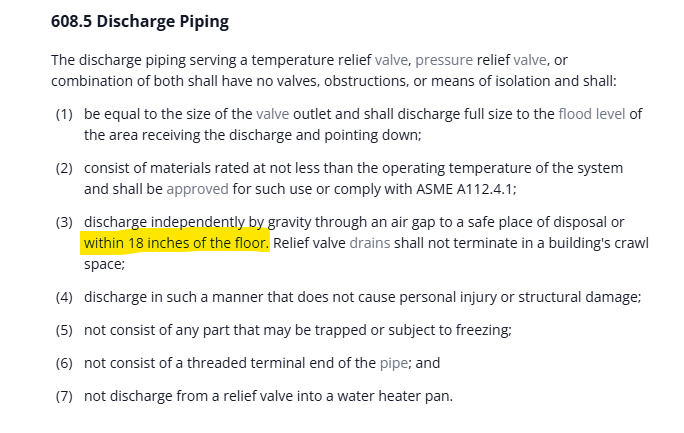
2 Likes
This is definitely a case of you need to know your local plumbing codes, not what someone says is fine or not fine for their own state.
In my area, it needs to go outside. Which I realize is not a common requirement in most other places.
Location, location, location. It matters.
4 Likes
Yes, I’ve never understood how some of these are ever allowed.
2 Likes