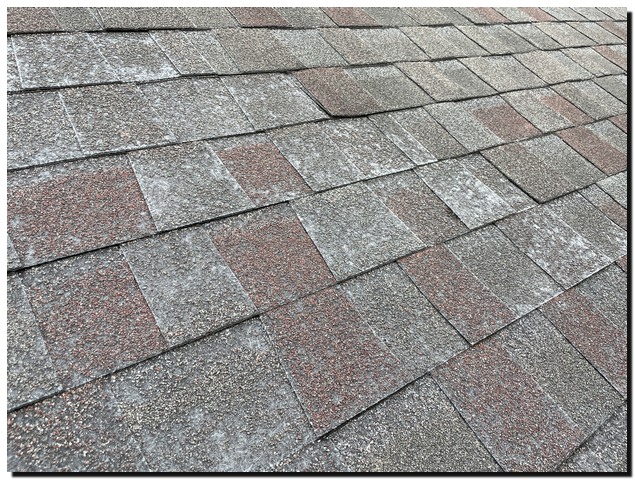
Most inspectors will see entire roofs with significant granule loss due to age, however you will eventually see some roofs with a pattern of granule loss attributed to a few bad bundles. The majority of the inspectorrs will know asphalt shingles are constructed in layers, see below:
Beside color the granules help prevent premature aging of the underlying asphalt layer due to UV light. As with most products produced in large qualities some defects slip through the cracks and get delivered to the jobsite. One critical issue is the depth of the asphalt layer the granules are embedded into. Granules should be embedded approximately 50-75% of their diameter into the asphalt coating. Improper embedment can result in granule loss over the entire roof or a bad batch of shingles are mixed in with good shingles creating a pattern of bad shingles you can see from the road. Here is a photo from yesterday showing the pattern from a distance (zoomed in with my camera) and a photo up close. (Shingles are 19 years old)
I write this up as premature aging likely due to a factory defect
How can a normal inspector keep out of trouble from saying it’s a factory defect when it really is from improper venting? Or the seller has the common amnesia on when the shingles were installed, and they are 10 years older than claimed.
There is a reason I ask. A few years ago, a new inspector in my area told a buyer not to worry about the bad shingles on a home. Wait until after they close, then they can file a claim against Certaineed for a free new roof. They took his advice. Turns out that they were OC shingles and it was not a defect at all. They filed a suit against him. In return, he closed shop and shut off all contact.
The inspector that got in trouble was partially because he was new and inexperienced. The bad bundle or two follows the pattern the roofers used, it’s not random. If you look closely at the second roof picture there is a distinct line between the good and bad shingles. Inadequate ventilation doesn’t do that.
I’m not questioning your expertise. It is always interesting to read the information that you post here. You are a huge asset to this page.
I wouldn’t consider myself new or inexperienced. However, if I see something like this, I note the damage and not speculation of what caused the damage. I look at these photos and what immediately comes to me mind is why is the damage concentrated to the first couple of bundles in the that one particular area. The odds of that happening there and not in other areas of the field seem low. I can’t answer that, so I don’t even try.
Definitely possible. In my area, ice dams are a real concern some years. People will use salt as well as roof rakes (basically a metal blade on a pole) to try and clear the snow and ice at the eaves. Both of these things can damage shingles.
Had to do a 4pt for someone recently. Family taking over home from dad who “kept up on everything” and on the phone said roof was only a few years old.
I arrived and looking at it from the ground, I’m thinking “ugh, that’s a rough few years”.
Anyway, did the inspection, they didn’t have the paperwork on the roof, so I pulled the permit. February 2008.
Water heater original 1994, HVAC(Trane) original 1994. I hated to break the news to them, the good news? it wasn’t the original roof. Dad didn’t keep up on much.
I take a more CYA approach:
“Pattern of granular loss may be from factory defective shingles. Further evaluation by a roofer is recommended.”
I see similar several times a year. The pattern is usually staggered up the roof as the roofer pulled the shingles off of a bundle of defective shingles.
I just shake my head. It’s a shame that any inspector would say something like that because even an inspector that absolutely knows those are Certainteed shingles and absolutely knows that a warranty claim can be made…that inspector should still refer the shingles for evaluation by a roofer to handle a warranty claim, before the client takes possessions and financial responsibility. Even if we are an expert in some trade or system, as a home inspector, we are generalist. We call defects or suspicions out for repair or evaluation by appropriate experts.
The CertainTeed situation is a pretty good example of how having experience as a roofer doing warranty work could get you in trouble. You start puffing your chest and proudly claim that you have done 100’s of CertainTeed roof warranties. You could spot one from a mile away. You put in your report that they can get a free roof by filing a claim. The buyer then finds out after closing that a claim has already been settled with the previous owner. Or the case with some shingle manufacturers, you get free shingles, but you still have to pay for labor. As a laborer, you never saw the contracts or invoices. So, you never had all the information needed to make such a bold statement.