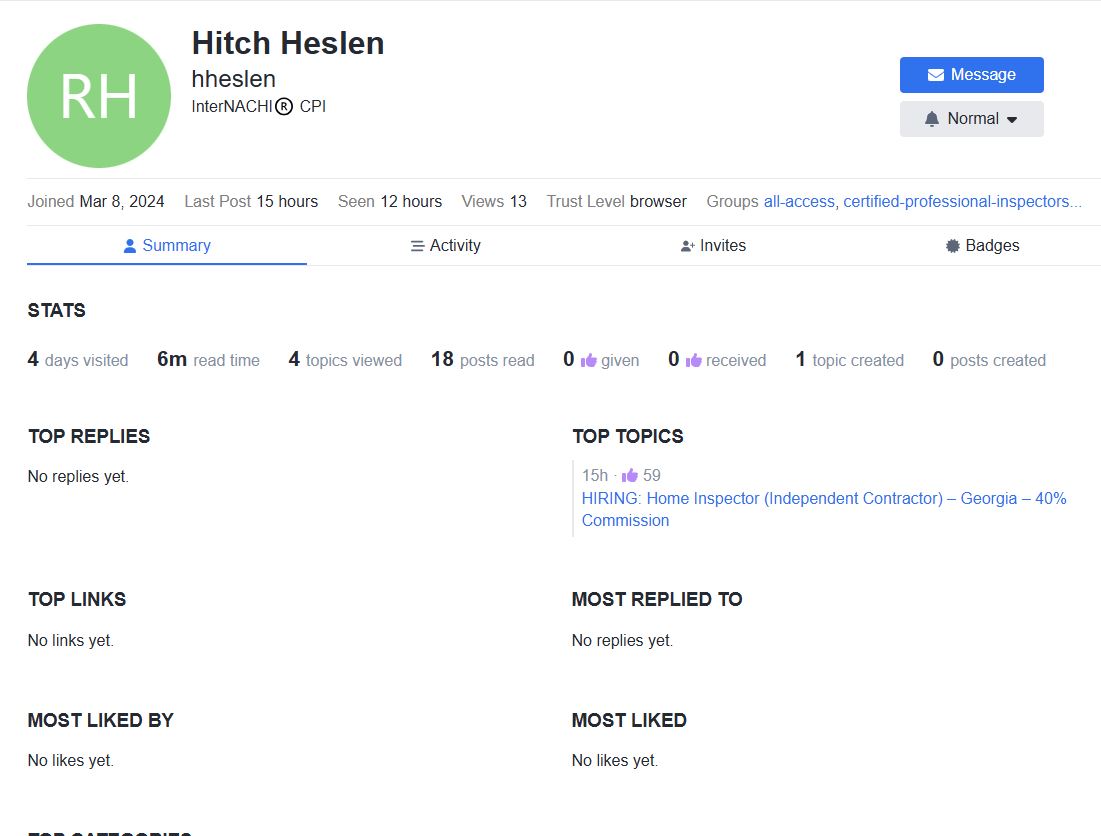
Peach State Home Inspections is expanding, and we’re looking for a reliable, detail-oriented licensed home inspector to join our team as an Independent Contractor.
We are a fast-growing inspection company serving the Metro Atlanta and Middle Georgia areas. We pride ourselves on professionalism, high-quality reporting, and exceptional customer service.
Position Details
Independent Contractor (1099)
40% commission per completed inspection
Consistent schedule opportunities
Support from an established, reputable inspection company
All scheduling, customer service, and marketing handled in-house—you focus on inspecting, we handle the rest
Requirements
Licensed/Certified Home Inspector (InterNACHI, ASHI, or state certification)
Must carry general liability & E&O insurance (or be willing to obtain)
Reliable transportation
Strong communication skills
Ability to use modern reporting software
Professional, punctual, and customer-focused
Preferred but Not Required
Experience with residential inspections, pre-drywall, foundations, crawlspaces, or specialty inspections
Experience inspecting manufactured homes is a plus
What We Offer
Steady flow of inspections
Competitive 40% commission structure
Opportunity to grow with a company known for integrity and excellence
Back-office support so you can concentrate on the inspection itself
Fast pay and consistent workload for qualified inspectors
About Us
Peach State Home Inspections is an established Georgia inspection company trusted by real estate agents, homeowners, and builders across the region. Our inspectors are known for thoroughness, professionalism, and clear communication. We set high standards—and help you meet them.
How to Apply
Email your resume, license/certification info, and a brief introduction to:
In ohio if You are scheduling the work what You are describing is an employee not a 1099 sub contractor….You might want to check that the IRS is kinda funny about those things…..
I hear most other Georgia multi-Inspector firms are paying 60% - 75% commission. That is unless they are providing E&O, Vehicle, Tools, computer, software, training, and all other items described above.
What’s up in Georgia are times getting hard there for Inspectors?
A person would have to be desperate or just plain stupid to work under those terms. You want them to essentially be self-employed and give you 60% of their earnings. I feel sorry for anyone who would agree to those terms.
They should call me instead. I’ll coach them one-on-one for a small fraction of the cost, they will build their own brand in the process, and always be completely independent.
Yes, that’s for sure. I had a couple of partners and we did the multi-inspector thing for a while. We would not have hired anyone who had so little self-respect and such low self-esteem that they would work under terms like that. We paid based on experience but we covered all the costs for all inspectors, including the least experienced inspectors, and we paid them a decent wage.
If I were that desperate for work, I’d go work as a greeter at Walmart before I’d agree to assume all that risk and all that expense while they rake in 60% off the inspection fee. An inspector would do better to use one of the overpriced services like Angie’s List.
It costs money to acquire business. Right around 5% of the average inspection fee is all it should cost to acquire business. The company that is recruiting is assuming no risk whatsoever. A 10%-12% finder’s fee would be on the high side of reasonable. A 60% fee is offensive.
It is so offensive that any inspector who is thinking of taking such a deal is welcome to call me. I’ll give them some guidance to help get them started on their own for no charge. I’ll trust them to throw a few bucks my way once they have some money coming in and if they saw some value in my assistance. If they don’t, that’s OK too. I’ll sleep well either way.
As described, the job is in complete non-compliance with tax laws.
This is pretty much a Webster’s Dictionary definition of an employee (therefore, NOT a 1099 independent contractor):
All scheduling, customer service, and marketing handled in-house—you focus on inspecting, we handle the rest
I know nothing about your operation other than what’s posted here but it doesn’t appear to be too well thought out. You might want to run this post by a labor and/or tax attorney.
Anyone who is considering this offer, be sure to remember that you SHOULD also be verifying the potential employers qualifications as well as a full interview, if they make it that far in YOUR process!!
I would expect that it happens the way you describe it.
I have had a number of different E&O carriers over the years and all of them did have a multi-Inpsector coverage for those companies hiring people. I never paid any attention to the details as I had no employees. What would be interesting to know is how E&O and liability insurance providers treat this 1099 situation? Do they have any issues, disclaimers, etc., that Inspectors need to be aware of? Again I was never there so never asked or had it presented to me.
One more thought on the $150.00 cut for Inspectors. How many are aware as 1099 contractors that they are required to pay all of their income tax, Social Security Tax, Medicare Tax, and all other tax liabilities. They will also be responsible for all of their own costs to operate as an Inspector. If they have a working spouse they file jointly with, and if they have income producing investments, that can really screw up trying to calculate their required quarterly payments to the IRS. I usually just took out 25% every quarter just to ensure I would not be writing a check to the IRS at the end of the year. That would mean just for taxes they could be paying out about $25 - $38 per inspection (approximately 15% - 25%) leaving them with a whopping $112.00 - $125 to cover all other expenses as well as to live on.
With those figures a job at $15.00/Hour would give them $120 gross for an 8 hour day minus taxes and all they have for expenses really are traveling costs to and from a job. Even a fast food or other job would pay a good chunk of medical insurance premiums and provide other benefits like paid vacation, possible bonus’, etc.
Myself I would never consider starting my truck and rolling down the driveway for a 40% cut!
It’s the other way around. A general contractor is responsible for the work of his subcontractors. If he is sued, he can try to sue his subcontractor, or his insurance company could try to subrogate to the subcontractor’s insurance company, but they won’t likely get far. The inspector can show that he is really an employee, not a contractor. That’s obvious from the job description posted here.
From 2009-2011I worked as a project manager for a GC. He had subs doing our roofing and siding. They were required to have GL & workman’s comp. We scheduled all of their work and paid out completed jobs the end of every Friday. All was good.
That was until it wasn’t. The company owner of the roofing sub decided to skip town and not pay his employees after completing a 470 sq project. The employees went to a non-profit community activist group. The group came after the owner of the company that I worked for. They demanded that he pay them, claiming that they were his employees. The owner showed them check stubs that he paid the company. He also showed documentation of insurance & contractor’s license of the roofing sub. This did not matter to them. They then printed up door hangers and canvased the neighborhood he lived in saying he was committing fraud. They also protested outside his house. This was not enough to get him to pay. So, they went to the department of labor and the IRS.
Both the DOL & IRS went after him for unfair business practices and back taxes. Because we scheduled the work for the roofers, they were considered employees. The work orders we issued for each job to the sub were not considered detailed enough to be considered contracts. This also made them employees. The IRS made him pay back taxes. The DOL found that all future & back workmen’s comp claims for the roofing sub-contractor employees would go against him. This was then escalated where they investigated the relationship to the siding sub. They came up with the same decisions for the siding company.
To add insult to injury, the company went bankrupt that was to pay us for the large roofing project. All of this ended up closing down his company.
So, I go back to my original question. Who pays for a claim against GL & E&O? If a claim is made, why would the “Independent Contractor” not close up business and skip town? They were after all, an employee.
Also, if you prevent an “Independent Contractor” from growing their business and competitively competing against you, they are an employee.
 [email protected]
 404-913-3346