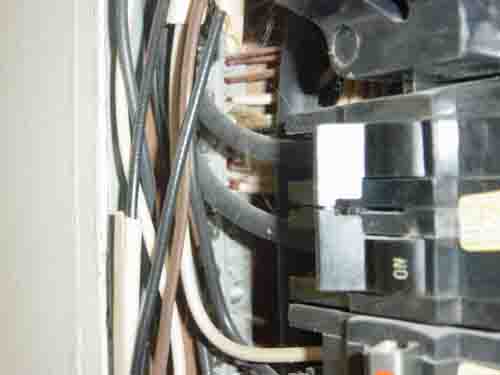
and thank you Robert I stole this list from you  
-- I have put the past behind me,
where , however, it now sits, making rude remarks.
Originally Posted By: roconnor This post was automatically imported from our archived forum.
jpeck wrote:
First and foremost, that is an FPE panel and must go.
Jerry tends to be very hard on FPE panels ... and rightly so. But IMHO he is more qualified to make that call than most HI's. Some sparkies do not agree that it "must go" automatically just because it's an FPE panel (as I think "what is wrong with their thinking ... maybe they just dont know/understand" ... but they are the professional you defer to). So be careful there. Ask Jeff Pope.
IMHO, an FPE panel is an automatic flag for further evaluation by an electrical professional, and in some cases IF ya know what you are talking about, and can back it up, it's a red flag for replacement.
I dont see the double tap neutrals either (maybe I need glasses or a better pic ... lol). But just so ya know, double tap grounds are usually okay (check the panel label for details), but double tap neutrals is a no-no.
-- Robert O'Connor, PE
Eagle Engineering ?
Eagle Eye Inspections ?
NACHI Education Committee
I am absolutely amazed sometimes by how much thought goes into doing things wrong
Originally Posted By: jpeck This post was automatically imported from our archived forum.
rmoore wrote:
I think I found Waldo...
They look like they go into separate terminals, but I can't tell from the photo. On the other hand, the the grounds near the top obviously go into the same terminal.
As Robert said, many (but not all) panels allow two grounds to be in the same terminal. The label will tell you if it is okay, and, if okay, how many of what sizes. I.e., 2-12, 2-14, but not 2-12 to 14. The first wording allows 2 #12 AWG OR 2 #14 AWG in one terminal, but does not allow a #12 and a #14 in the same terminal. The second wording would have allowed the different size conductors in one terminal, and you will seldom see that (I've only seen it once or twice).
Originally Posted By: chorne This post was automatically imported from our archived forum.
Hi,
the transformer appears to be the power supply to a thermostat
for a gas fired or oil fired heating system. They are either mounted
inside of the electrical panel or on the outside of the panel. (typical
24-V ac transformer.)
I agree, Jerry P. is probably more qualified to recommend (or in his case, insist ) straight out replacement. But IMHO, anyone calling themselves a home inspector is obligated to call for further evaluation of FPE panels.
-- Jeff Pope
JPI Home Inspection Service
"At JPI, we'll help you look better"
(661) 212-0738
Originally Posted By: jpeck This post was automatically imported from our archived forum.
Mike Parks wrote:
Robert
Using the 1993 NEC, 373.8
Mike P.
This should get interesting, that is one of my favorite code sections. 
From the 1996 NEC (same 1993)
373-8. Enclosures for Switches or Overcurrent Devices.
Enclosures for switches or overcurrent devices shall not be used as junction boxes, auxiliary gutters, or raceways for conductors feeding through or tapping off to other switches or overcurrent devices, unless adequate space for this purpose is provided. The conductors shall not fill the wiring space at any cross section to more than 40 percent of the cross-sectional area of the space, and the conductors, splices, and taps shall not fill the wiring space at any cross section to more than 75 percent of the cross-sectional area of that space.
From the 2002 NEC (same section, new location)
312.8 Enclosures for Switches or Overcurrent Devices.
Enclosures for switches or overcurrent devices shall not be used as junction boxes, auxiliary gutters, or raceways for conductors feeding through or tapping off to other switches or overcurrent devices, unless adequate space for this purpose is provided. The conductors shall not fill the wiring space at any cross section to more than 40 percent of the cross-sectional area of the space, and the conductors, splices, and taps shall not fill the wiring space at any cross section to more than 75 percent of the cross-sectional area of that space.
Looking forward to this. It all depends on how you read it, then I'll tell you how it is read and how it relates to the UL Standard 67 these are tested, listed and labeled to, per my discussions with UL Senior Engineers.
Originally Posted By: roconnor This post was automatically imported from our archived forum.
Mike Parks wrote:
Using the 1993 NEC, 373.8
Ahhhhhh ... looks like there is adequate space (I'm assuming you meant your usual 1999 NEC reference).
I thought for sure you would quote listing/labeling or 1/4" clear required between 120V and the low voltage doorbell wiring ... but the latter would be easy to fix in that panel. The listing/labeling is a bit more sticky, but IMHO beyond a home inspection.
-- Robert O'Connor, PE
Eagle Engineering ?
Eagle Eye Inspections ?
NACHI Education Committee
I am absolutely amazed sometimes by how much thought goes into doing things wrong
Originally Posted By: jpeck This post was automatically imported from our archived forum.
roconnor wrote:
Mike Parks wrote:
Using the 1993 NEC, 373.8
Ahhhhhh ... looks like there is adequate space (I'm assuming you meant your usual 1999 NEC reference).
Robert,
What does "looks like there is adequate space" have to do with this?
From the 2002 NEC (same section, new location)
312.8 Enclosures for Switches or Overcurrent Devices.
Enclosures for switches or overcurrent devices shall not be used as junction boxes, auxiliary gutters, or raceways for conductors feeding through or tapping off to other switches or overcurrent devices, unless adequate space for this purpose is provided. The conductors shall not fill the wiring space at any cross section to more than 40 percent of the cross-sectional area of the space, and the conductors, splices, and taps shall not fill the wiring space at any cross section to more than 75 percent of the cross-sectional area of that space.
Originally Posted By: roconnor This post was automatically imported from our archived forum.
jpeck wrote:
What does "looks like there is adequate space" have to do with this? [312.8]
The first sentence of 312.8 ends with "unless adequate space for this purpose is provided" which qualifies everything there. The second sentence of 312.8 is all about the percentage of wiring space filled.
That section Mike referenced and you posted is all about having adequate space ... 
-- Robert O'Connor, PE
Eagle Engineering ?
Eagle Eye Inspections ?
NACHI Education Committee
I am absolutely amazed sometimes by how much thought goes into doing things wrong
Originally Posted By: jpeck This post was automatically imported from our archived forum.
roconnor wrote:
The first sentence of 312.8 ends with "unless adequate space for this purpose is provided" which qualifies everything there. The second sentence of 312.8 is all about the percentage of wiring space filled.
Sort of right, but that means it is wrong.
(title) 312.8 Enclosures for Switches or Overcurrent Devices.
(first part of the first sentence) Enclosures for switches or overcurrent devices shall not be used asjunction boxes, auxiliary gutters, or raceways for conductors feeding through or tapping off to other switches or overcurrent devices,
(exception to the first part of the first sentence) unless adequate space for this purpose is provided.
(note: this specifies that the space must be: 1) adequate space, and 2) provided for that purpose)
(second sentence clarifies the exception above) The conductors shall not fill the wiring space at any cross section to more than 40 percent of the cross-sectional area of the space, and the conductors, splices, and taps shall not fill the wiring space at any cross section to more than 75 percent of the cross-sectional area of that space.
I called UL many years ago and asked "Is space *provided for that purpose*?"
Their answer, which accompanied discussions about the sections of UL Standard 67 to which these are tested, listed, and labeled, was "Absolutely NOT."
This was followed by further discussions on "What is the maximum current allowed to pass through on those conductors? The space requirements and limitations are stated in the code, to limit crowding in the panel, but the code specifically states *shall not be used as*, with an exception. Can you pass 200 amps through a panelboard? What effect would that have on heat rise in the panelboard? If a manufacturer wants to use their panel enclosures as a raceway, than they need to advise us of the maximum limit of current they want to allow, then a Standard would need to be developed for that, along with specific tests for it, after which these could be tested, listed, and labeled for use as a junction box or a raceway, and with a stated maximum pass through current."
The discussion went on, but you get the idea. There is currently NO STANDARD to which these can be tested, listed and labeled, thus the code applies as "Enclosures for switches or overcurrent devices shall not be used asjunction boxes, auxiliary gutters, or raceways for conductors feeding through or tapping off to other switches or overcurrent devices,", and the rest is not yet applicable, not until "space for this purpose is provided".
Those discussion resulted in this letter from them. The signor of the letter is the low man on the totem pole of those I talked with, the most senior Senior Engineer, Arnie Schaeffer, said that John will write the letter.