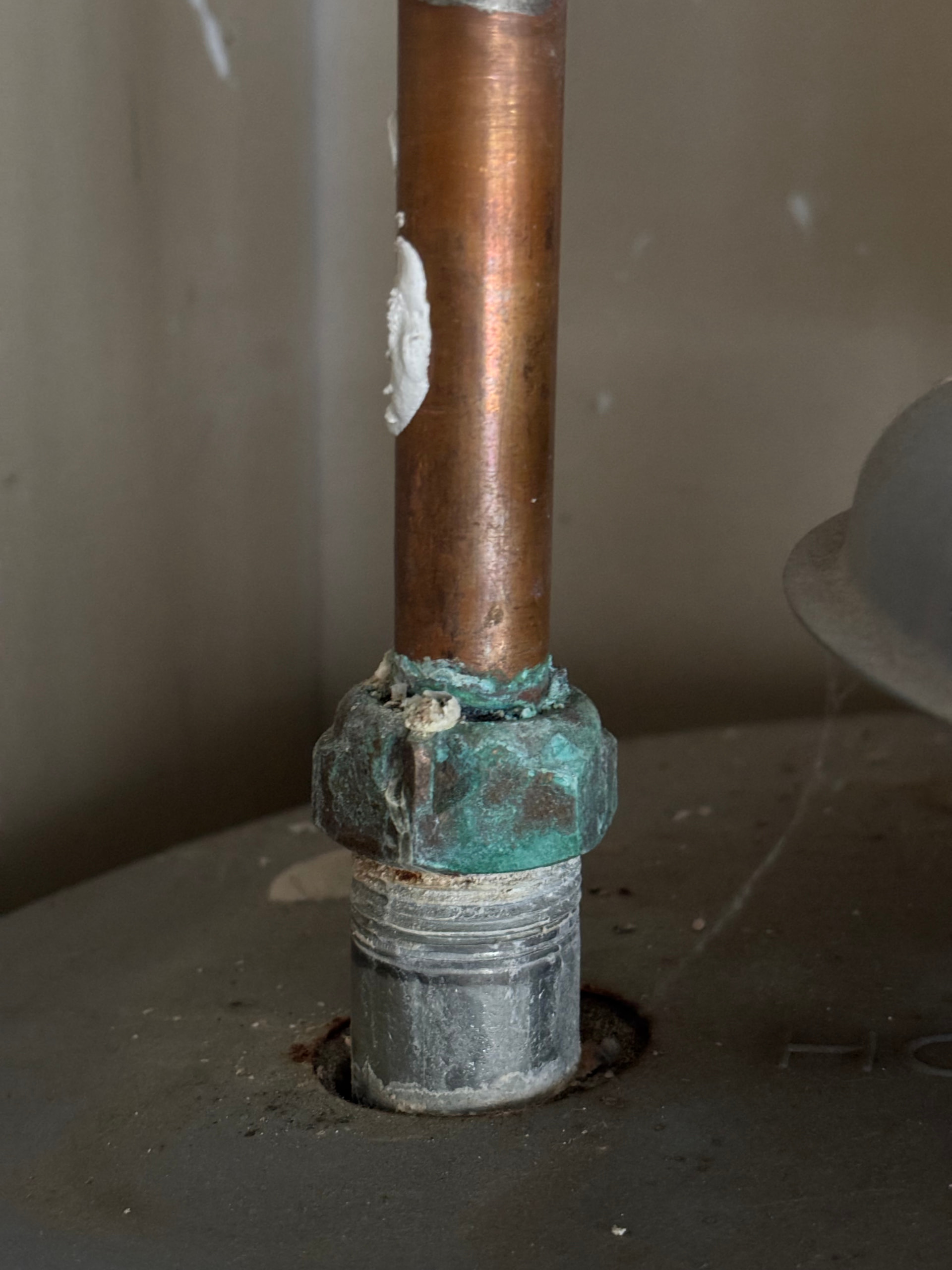
Hi all. I’m looking for some advice on narratives for corrosion on water heater inlets:
(1) Any tips on identifying whether it’s galvanic corrosion, leaks, or something else? My understanding is that galvanic corrosion is less common as a cause in this spot (cold water inlet) as most water heaters now come with dielectric fittings, so I find myself usually writing these up as “likely leaks,” but any advice would be helpful. On the first photo, I’m pretty sure it’s a leak (esp given the discoloration on the pipe above the corrosion); the second one I am less sure about.
(2) When to recommend calling a plumber NOW versus when water heater is replaced? For example, for the first photo I’d recommend a plumber now (WH is 8 yrs old), second photo I’d recommend just monitoring until WH needs replacement (WH is 17 years old so will likely need a plumber soon anyway)…
I’m a new inspector and trying to steer clear of over-recommending expensive consults to clients - while also being mindful of liability. Would welcome any rules of thumb you all use!
As home inspectors, we do not need to determine the cause (galvanic corrosion or otherwise). Just describe what you see. I would say heavy corrosion on the first and light corrosion on the second.
My understanding is that the galvanized pipe inside the water heater has a inner plastic sleeve that protects it from galvanic corrosion. However, the exterior of the pipe has no such protection. If condensation is forming on the cold water inlet due to the cold water flowing within the pipe inside a warm humid room then, because of the two dissimilar metals, galvanic corrosion is likely occurring at the exterior surface. Insulating the pipes to reduce condensation would help. However, prescribing a specific remedy is not your job - leave that to the plumber.
Good questions. I’ve often wondered the same as it’s sometimes hard to tell exactly what’s causing it. I’ll generally write it up for correction unless I’m also writing up the appliance for end of life in which case I include a picture of the corrosion.
Water heater inlet Galvanic corrosion.
From what I recall.
Signs: Discoloration at the terminals. Electric, Chalky white or, gas fired, brown build-up around the terminations of dissimilar metals.
Sacrificial anode. Foul-smelling hot water. Rumbling noises in the vessel. Visibly degraded rod.
Leaks. Use a paper towel. Older leaks usually have advanced stages of corrosion buildup. Visible leaks, bulk water.
Recommend further evaluation by a licensed plumbing contractor when you notice ‘any suspect condition.’
After 10 years of age. Recommend replacement within the next 12 months if there are not signs of degradation.
NOTE: Many if not most Insurance companies recommend water heaters be replaced every 10 to 12 years. Repercussions from leaks to ruptures are costly.
Glean the serial number.
Insurance companies around these parts are starting to require 15YO perfectly working water heaters to be replaced.
I’m of the opinion that a water heater, sitting 18 inches from the garage door, in the garage, should be run until it doesn’t run and can’t be reasonably fixed(like an element).
I replaced my 1998 water heater this year. The only reason was to get some energy savings with a heat pump water heater. Which, by the way, brought my electric bill down around 15-20/month. In the cold season, like right now, it runs a bit more so the savings won’t be as good but I’m sure it’ll still be better than before.
Agreed, been seeing that for several months, it doesn’t matter what the unit’s condition is at all. Clearly, they are writting checks for damage tied to water heaters.
I tell customers that the average life around here is 15 years. That means I’ve seen one dead at six and one chugging along at forty. I’ve considered raising that average to 18 years because, I see so many still working at that age. At 18 years, they typically have 3-5 gallons of sediment sludge in the bottom, but still making hot water. I’ve heard a few plumbers tell our customer that the water heater should be replaced when the seven-year warranty expires. (I’ve heard a few HVAC guys say furnaces have to be replaced at fifteen years.)
For fun, I just checked. AI says that traditional tank-style water heaters typically last 8-12 years. That just tells us who is doing most of the publishing…and it is not us.
If it’s a Carrier heat pump, that’s true. Not because of a rule or something, just because at 15 years, chances of it working another 12 months are very low.
If you made it to 15 with your Payne, Air Temp or some other “off brand”, you’re already on borrowed time.
I personally would not care about the “why” factor. You are on site to observe concerns, but not to speculate why. Either way, good catches, and I would just recommend to monitor and replace as needed. In my opionion and my thoughts:
Image 1 is definitely galvanic corrosion. This could have sealed itself of years ago by rust
Image 2 looks to be a more of a patina from condensation on the hot side - caused by sweat from temperature changes. This likely is a non issue and more of just a normal expectation to see with an aged water heater in a garage in a colder climate.
You know how I looked at it Marcel. How well a home inspection business did over a period of time.
How many paid for home inspections have you complete with your company?
I am sure the InterNACHI members would like to know.
You do inspections as your primary source of income or was it part time?
I have done thousands of PIAD for inspection. Full time.
I have been on the news numerous times. Still have journalists call my home to contribute in an investigation.
Had independent articles written about my company and myself.
Been in front of provincial housing inquiry after being vetted.
Yourself?
So sorry. I thought you were referring to the ‘home inspection industry.’ “How can you argue with a CMI.”
How many inspections have you done with your company?