You learned from someone else who knew what they were doing with the IR.
Next, you need to know not just that it is hot, but by looking as the scan, why it is hot. Patterns tell a story.
Because it is hot, does not mean it’s bad. On a parallel three-phase motor connection you’re talking about, hot do you know which circuit has the problem?
Wow, that’s a bunch of old timers!
I guess you’re right about that. One or two pop up now and then.
The “Dirty Dozen” formed up with Dale Duffy was a formable team that worked together to advance IR and the commercial inspection industry. IR has faded away from “look what we can do with this IR stuff” to “can someone tell me if this is too hot”. We all packed up and attended a Firestone Roofing seminar for architects to learn what we were pointing our cameras at during our commercial inspections.
Today INACHI “certification” is believed adequate, and it gives you a badge to put on your website. That is just a starting point. The certification points you in the right direction going forward. So Robert Meier, to answer your question, yes this is a lot for a HI to take on for a Home Inspector. The bright side is most have some idea of how a house is put together and what they are pointing the camera at.
When I took Lvl III training at Flir, the course was rewritten by Dr. Madden and all Lvl III trainers for ITC were required to attend. These guys came from every industry imaginable. When we got to Building Science, the three of us in the course (my Building Science instructor included) who specialized in building inspections were called upon to share our expertise with others because even Dr. Madden was not proficient in that aspect of thermal imaging. My point posted previously that IR in Home Inspection is one of the most complex uses of IR. I just wish camera owners took it that seriously.
David, thanks for the response. I’m not trying to sound like a broken record but the information in this thread is all over the place regarding whether or not a home inspection report containing IR information is accurate. I’m only asking because I have on occasion reviewed reports that contain IR data and I am wondering if it can be deemed reliable.
This brings me back to one of my questions. The OP mentioned a 30 amp circuit feeding a water heater. If this were a typical 240 volt, 3500 watt water heater
wired with short run of #10 conductors what would be the expected temperature reading be at the circuit breaker in a room with an ambient room temperature of say 75°?
I don’t presume to answer for Dan. I can only say that I think a lot of factors would go into that number. What I can say is that after I’ve run the water for a length of time and the heater has been running, I see about 8-10 degrees higher but there are so many variables. I typically see this.(See image, lower right ) It’s warmer than the other breakers and warmer than it was. With gas heaters, the minimal electric usage won’t typically be seen and if it were with my camera, I’d be concerned but that hasn’t happened.
Thanks Mark. So if I may one more question, at what temperature differential would you see as a cause for concern that may require further investigation?
I think that we (may) have established that breakers under normal load and AFCI/GFCI breakers are typically 5 to 10 degrees warmer. So, IMO a breaker that is 15, 20, or 25 degrees warmer should merit further attention (i.e. looking for anything visibly wrong, measure amperage).
If something is really hot, it washes out everything else. So to echo the above, if I saw 15+ or more, I’d look into it. I’d probably check amp draw on each leg, check the terminals, make sure the bus bar hasn’t welded itself to the breaker etc. It may or may not mean anything. If it was really hot, as in approaching 140, I’d probably get on the horn with the REA, turn off the breaker and flag it for an electrician to do a proper evaluation.
Robert - Sorry for the delay. Had company in town.
What Mark said is the missing link when determining how hot is too hot.
The next thing is if the thermal was verified. Just like a flashlight down in a crawlspace, when you see something suspect, you investigate further. Water stain, is it wet? Where is it coming from? If it’s dry, what conditions (unlike the present) might it have occurred?
When I do industrial electrical IR, if any breaker shows warm I determine what the load is then pull the dead front to get the whole picture and take amperage readings. Regardless of the temperature, you don’t know anything when it has to conduct through the breaker to where the camera can see it. Where in the breaker is the source of the heat? What is the temperature of an electrical arc?
Temperatures of an arc flash can reach as much as 2,800 to 19,000 °C (5,000 to 35,000 °F).
This is why we can not guess what is too hot.
After doing a bunch of these, you get an idea of what may be a concern, but it requires additional verification. So you can not really look at a report and determine its accuracy.
The report should include additional scans of total visibility of the breaker. These patterns that show up will give you an idea of the cause of the heat. If they don’t provide those and the load on the circuit is not listed, I would question any report without that.
I just started reading this thread, sorry if I’m late but IMO Level 1 certification is the BARE minimum. I see too many HI that take the Internachi Courses (nothing against the Internachi courses but they are just introductory courses IMO, not training courses) get a camera, and get themselves in trouble.
If this is something that is so helpful in our trade, is it possible for INTERNACHI to put together a more comprehensive course? It looks like the classes offered were produced many years ago. Not that I look to InterNACHI for 100% of my training , but if these trainings are going to get inspectors in trouble, it should be disclosed. Do I now question all the other classes as just giving enough info to get into trouble?
If you follow the SoP, you will understand we are generalists, not specialists. If you cross that threshold into specialized training and operate outside the SoP you are on your own. NACHI does a nice job preparing you to offer additional services but the responsibility will be yours and how far you want to hang your backside out to dry.
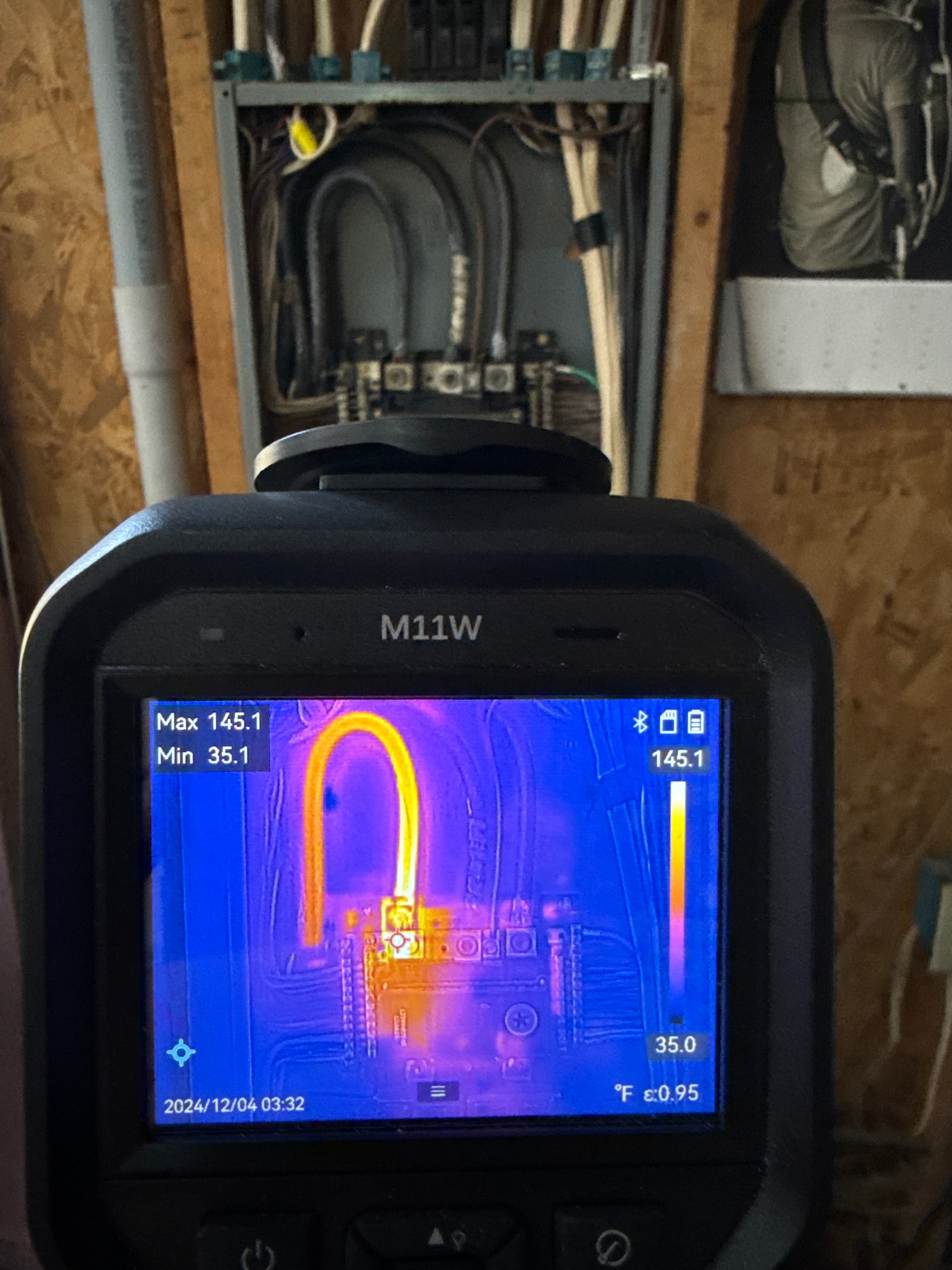
What’s the consensus on this picture from this morning?
The garage is not heated so the temperature inside was the same as outside, 35°F.
One of the service entry conductors was warmer than everything else. Especially at the lug.
I recommended further evaluation by an electrical contractor.
My guess is they have half a dozen space heaters on one leg. Sum up the amp draw on that leg.
That would reach my level of call an electrician because if nothing else, some of those loads could be swapped over to the other bar just by moving up or down one.