Do you have a photo of the terminals? If the issue were all of the load on one leg then the neutral would be carrying about the same amount of current and should have a similar temperature.
7 Likes
I was thinking the same thing. My uneducated guess would be something wrong with the lug, like it’s under torqued.
7 Likes
Good recommendation, IMHO.
5 Likes
Look at the top curve of the neutral, it’s glowing too. I can’t tell, is there tape on the part near the lug or some kind of strain relief?
It’s hard to tell but if only the one leg were heavily loaded then the neutral would show near equal amount of heat. It appears that where it enters the lug the neutral is no warmer than the other leg to the right. What’s obvious to this type of question is that were merely guessing without knowing what was the amount of load on the conductors.
The load could be perfectly normal. An electrical flash is 5,000 to 20,000 degrees Farenheit. If the terminal lug is loose and arcing regularly, those tiny flashes will definitely heat it up depending upon the frequency. There seems to be no discoloration of the lug, so likely not getting much hotter than 145F. Good catch.
What was your range setting?
I agree it could be loose but one theory presented is that the one leg that is much hotter than the others had a lot more of the load. If that were the case then you would expect to see a higher temperature in the neutral.
1 Like
The heat on the curve of the neutral is radiated or convected heat from the hot leg.
2 Likes
Would you also agree that the hottest point on the hot conductor appears to be at the terminal?
1 Like
Yes, the hottest point was at the lug. The wire insulation was not melted. I put on a leather glove and i tugged on the wire gently and it did not seem loose. I didn’t over do it, I just checked that it wasn’t super loose, but it felt solid.
I had the same thought as Robert about the neutral not having any elevated temp.
The big question is load. Its a question because not a single breaker in that panel was labeled. 
it was 35°F outside so both heat pumps were running. the only other thing on was lighting and the dishwasher.
gas water heater. Stove off. microwave off. laundry off.
here are a few more pictures to answer some of the questions you guys asked.
the range setting was “automatic” and emissivity was set to .95
I did not do the lick test as I had, moments before, numbed my tongue with a fresh cup of coffee.


4 Likes
The lug connects to a small piece of bus that connects to the breaker so it is possible that the lug was properly tightened and not the cause of the problem.
2 Likes
Smart man! I was going to recommend getting closer because the spot size was questionable. Look what happened with a proper spot. There is an increase.

The nicks or cuts in the wires is also interesting. Possible temp increase due to resistance?
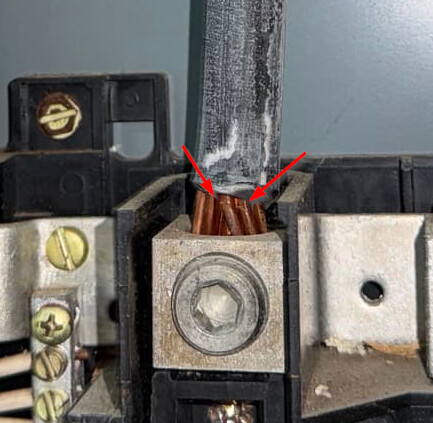

2 Likes
Nope, it has nothing to do with the load. It has to do with a loose connection, not necessarily at the, lug but behind the breaker.
The thermal pattern of the conductor and components is that of conduction heat transfer. If it were load, as most people perceive it as, everything would be the same temperature basically.
A gradient points to the direction to where the heat source originates.
If we tune the scan with an appropriate palette, this would become evident.
7 Likes
That is a $1,000 worth of training right there 
5 Likes
I recommended further evaluation by an electrical contractor.
Be careful with that.
If the electrical contractor does not have a thermal imaging camera and is educated in the science, how are they going to figure the source?
That’s why contractors that stand around in moon suits, taking panel covers off and testing amperage Etc , hire me for the big bucks to identify the issue so they can repair it on the spot.
1 Like
A really good electrician can find the problem with the information given. 
6 Likes
Thanks, David. I was hoping you would see this and give some insight.
2 Likes
I will agree that the issue is where the lug connects the to the bus and not a lug to conductor connection.
3 Likes
OK, my turn. Teach me how.
Based on this thread, most went for an overload.
That was with the thermal information.
How about without? Just wait till something fails or burns?
I know we got by before this IR stuff came about. I used an IR Thermometer when I was working HVAC diagnostics. Is there another or better way?
1 Like