That was not the issue I was looking for, but it is definitely an honorable mention. Fire egress safety concern.
1 Like
I don’t get it, the door opens to the exterior, what is the concern?
Door opens inward over a step.
5 Likes
Yes sir! Nice one.
3 Likes
I would see it to be more of an issue opening outwards in a snow zone.
The cure is a landing on the inside prior to the step down.
2 Likes
So, What happens when there is a three foot snow drift up against the door? I guess your dead ass is put in a body bag and draged out the door by a fireman. 
The door swings in over a step. It will not be blocked by a drift.
I think it would be more awkward standing on a platform opening the door and then stepping off the platform to allow for the swing of the door, it is only one step.
I am not really worried about an awkward exit as I am entering over a step. In general travel, people do not expect an immediate step down as they swing a door to enter. (that one step would probably end the good years of an elderly person).
As I mentioned, this may be an “Opinion Piece”. I always call out doors that swing out over a step without a landing.
Furthermore, you open doors all the time with landings… it is more than manageable.
3 Likes
WWWTP #1 – The Aluminum Track Window
@bcawhern1 most clearly identified the core issue observed.
On this type of window each track operates as a drainage channel. Water that hits the inner pane drips into the inside track, which has openings to the outside track, which has weep holes to the outside. In my area’s high year round high humidity climate, weep holes frequently get blocked with moss or debris and cease to function.
However, in this case the weep holes were NOT blocked. Instead somebody without a box of clues drilled a hole in the drainage track and (perhaps at a different time) ran a nail through the drainage track to pin one of the panes in place. @bcawhern1 drew an arrow on the drilled hole, and the nail is obvious. The drilled hole was neat enough it could easily be mistaken for a something from the factory, however…
What did the drilled hole do? Well these windows are so cheap there’s no flashing, no sloped sill, no drip edge, capillary break or anything. So that water that should have exited via the weep dripped into the wall, leading to:
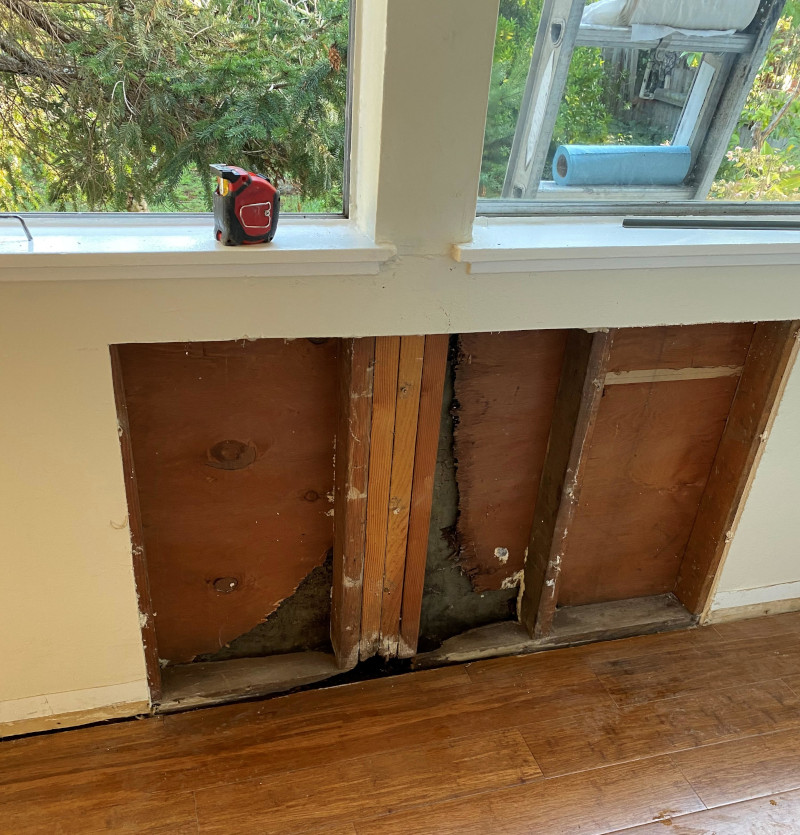
Leading to sheathing damage, damage to the center structural pillar, and a soft spongy floor. Likely, there’s yet more damage still concealed.
Moral of the story:
Significant damage can hide a long time.
The track is meant to hold water like a bathtub, and direct it outside.
There’s no backup in this window system: one crack or flaw and that’s it.
4 Likes
Anywhere there is a wall or roof protrusion or penetration, it is a potential water entry point. Good case study. Was any of this visible from the exterior cladding?
For WWWTP #1:
None of this was visible from the exterior stucco cladding. Zero.
One of four windows had clear evidence of a stucco repair. Some prior repair had taken the stucco off from the outside, notched in new pressure treated studs from the outside, yet missed the source of the leak and it rotted again. This repair resulted in new pressure treated studs with notches for the electrical, thus pressing the electrical against the interior drywall, another clear defect.
Each of the four windows was a mess in its own way. One of them the damage was not even apparent after the interior drywall was off. The inside of the plywood was fully moldy, yet the outer layer plywood layer was still intact, hiding the damage. The water had managed to drip mostly down the center of the plywood.
1 Like
Looked like nylon from here. The extensive damage to the power coating threw me off.
1 Like
Another issue with the step is that it doesn’t appear to be secured to anything. A loose step like that can do more harm than good.
5 Likes
What did the drilled hole do? Well these windows are so cheap there’s no flashing, no sloped sill, no drip edge, capillary break or anything. So that water that should have exited via the weep dripped into the wall, leading to:.
You are still not giving us enough pics, info, to go on. Looking at the rot pattern it does not look like the moisture and rot were caused by the hole in the window track. show a pic of the exterior where the two windows are mulled together.
1 Like
When moisture and water enter the drilled hole in the window track, the water is still contained inside the window track and can exit through the weep holes.


It was not that sort of window track.

I test window tracks the old-fashioned way: by pouring water into them and seeing where it goes.
3 Likes
That is not the same window, you are not giving all the info, so why bother posting.
5 Likes
Hah!
Good luck with that…
6 Likes